Race Day
Drive a lap with me through the process I took to create two levels for a “Race Day” - one Grand Prix circuit in a mountainous valley, and one street circuit in a beach town.
LEFT: Forest Track


RIGHT: Beach Town Track
I made conscious decisions about shaping specific compositions within the scenery that the player would move through. I decided to use Unreal Engine for this project. I got to work laying out the shape of the road using splines. I also wanted the overall difficulty of each course to be different. The Grand Prix circuit would be an easier course, allowing the player to stay at full speed most of the time, while the street circuit would be more challenging, requiring more awareness of racing lines, braking zones, speed control, and elevation changes.
Next is whiteboxing.


Before I even began whiteboxing, I drew out the layout of each track on paper.
I blocked in the largest elements in each level, and began shaping the terrain around the road splines in each track. Then I used flattened cubes to demarcate areas for trees, and also where the sand would meet the water in the beach town track. The next step would be to start painting the landscape.
However, I initially made a mistake; I made a new landscape object in each level, and sculpted hills on each one.
This was a mistake because:
multiple landscape files is harmful to performance.
a square of steep hills around each level is awkward and uninteresting.
I eventually deleted the second landscape in each level and expanded the main landscape to contain faraway hills and scenery.


Take a look at each track individually to see each composition both from afar, and from the player’s perspective.
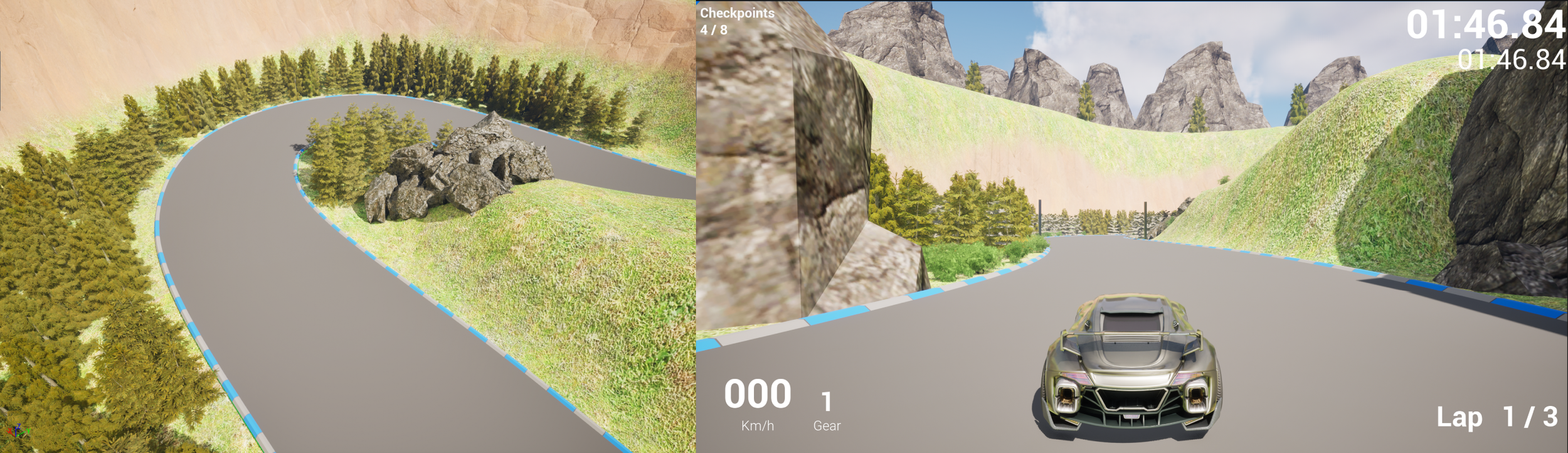
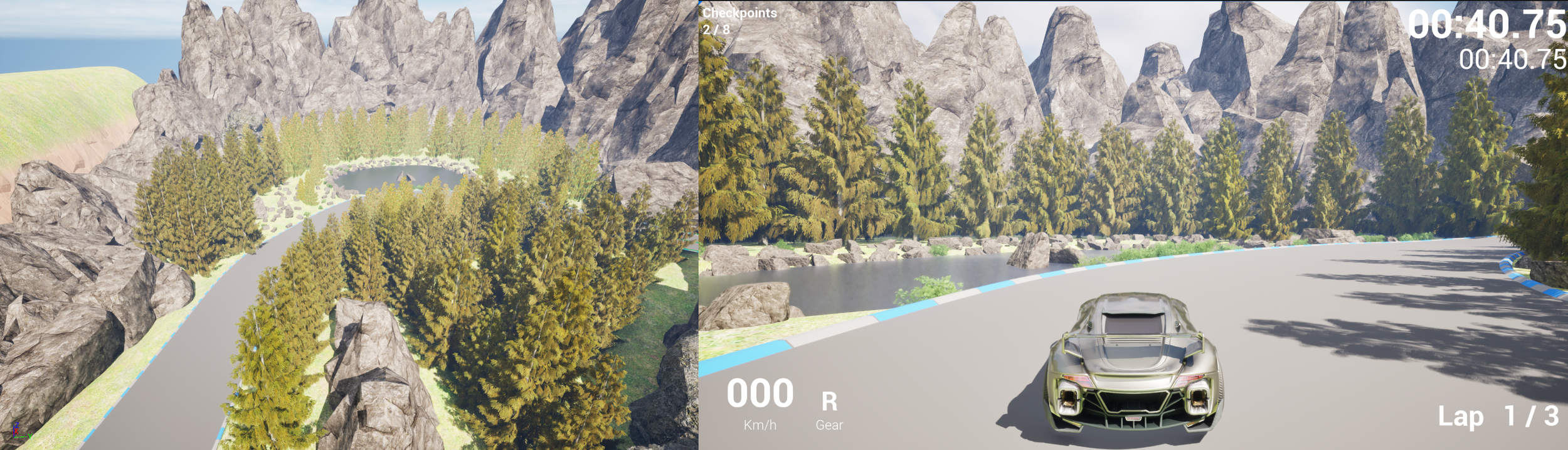
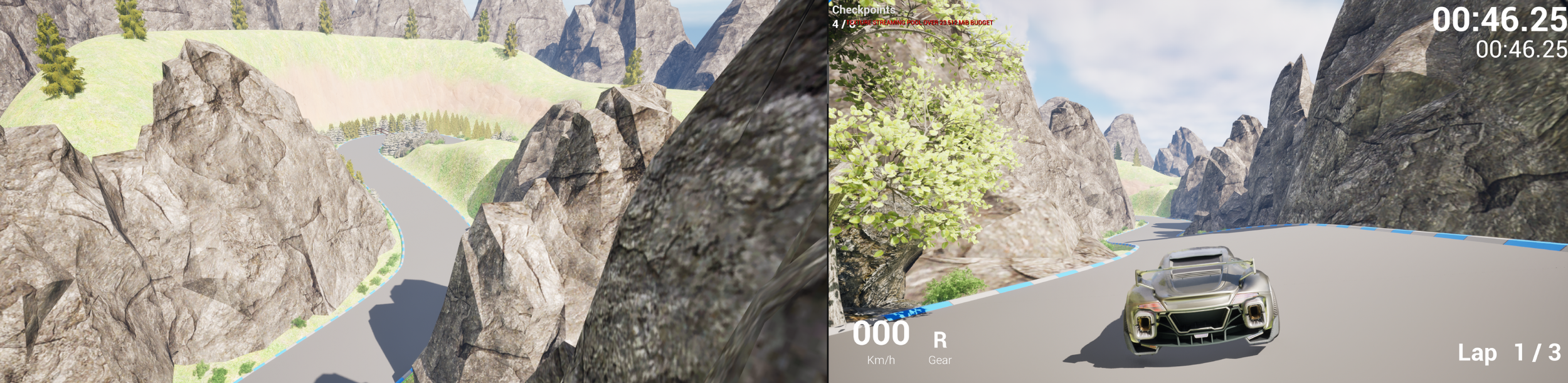
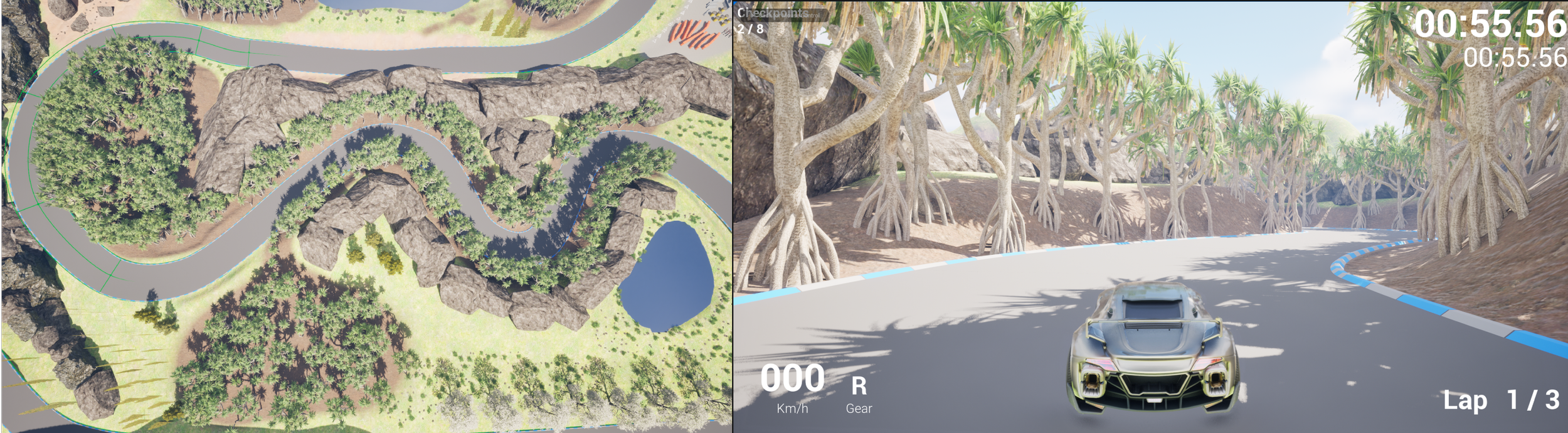
It’s important for these sections of each track to be distinct moments that capture the player’s attention - both in how the player has to adjust their driving by braking or steering, and by how the elements are arranged to make the space feel authentic and surreal simultaneously.
In the forest track, there’s a distinct focus on spaces that are contained and spaces that are open.
Spaces that are contained and closed off require a lot of focus to drive correctly, while open, spacious areas can be driven without breaking. How contained or open each space feels is a direct indicator to the player how focused they should be.
Here’s a lap of the Forest Track.
The next step would be to dress up the environment with compositions that had distinct foregrounds and backgrounds.
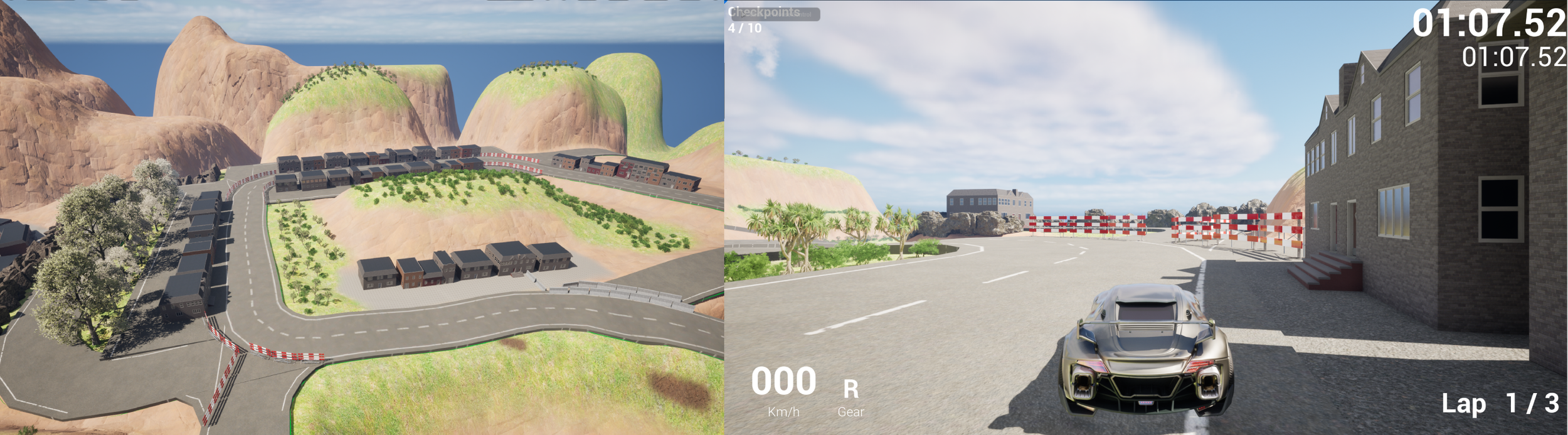
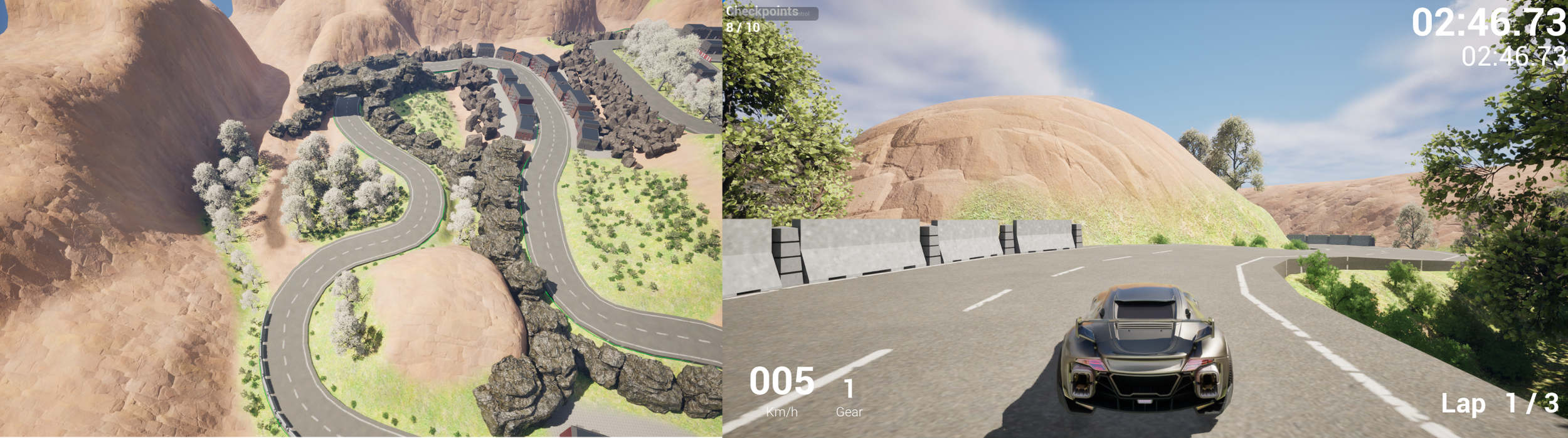
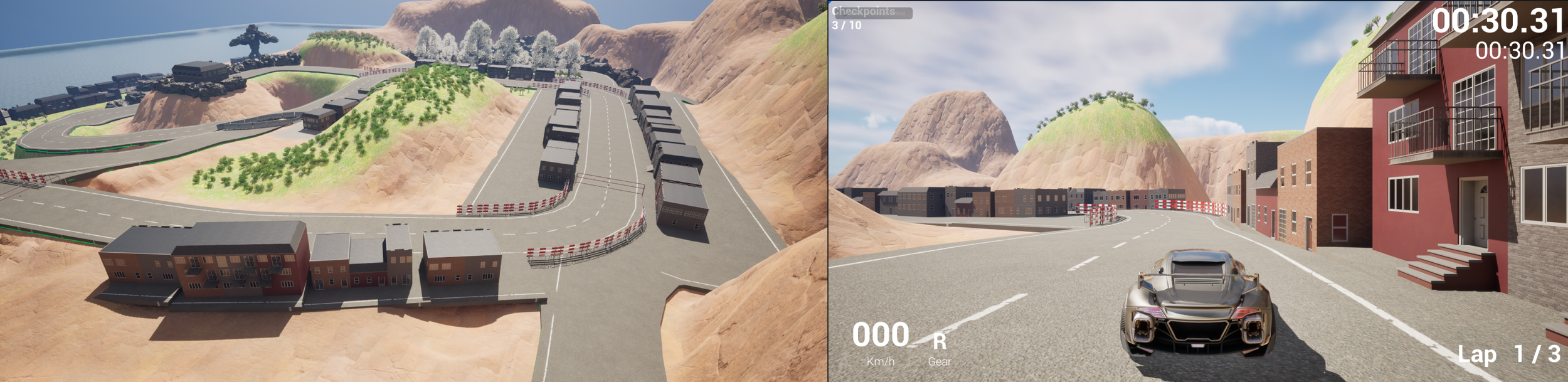
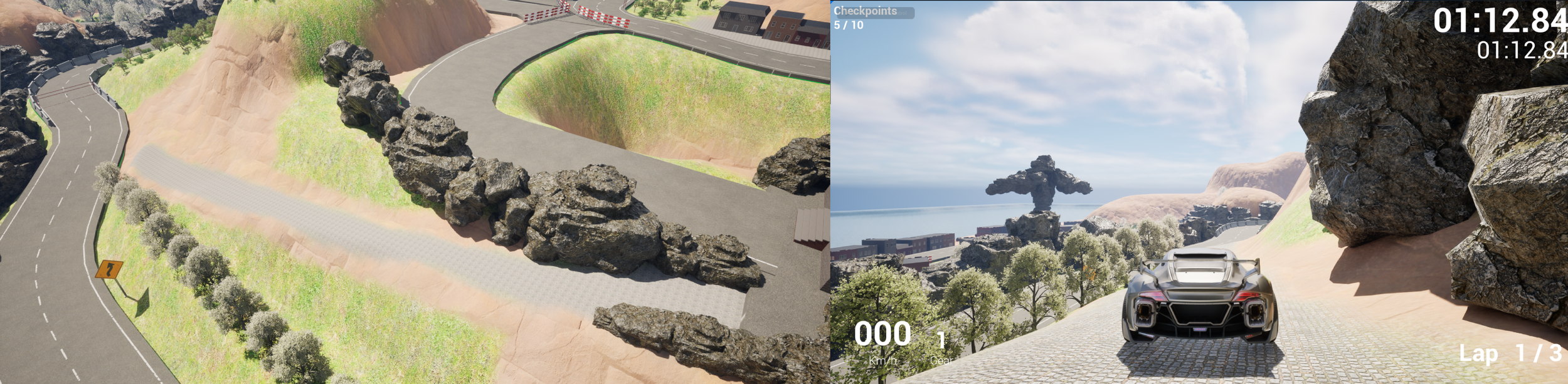
This, as well as the ever-changing elevation, demands focus from the player. Additionally, there’s an emphasis placed on shortcuts in this track. There are three shortcuts the player could potentially attempt to save time, and they are hidden in areas the player may only discover by slowing down and analyzing their surroundings.
This chicane is also deceptively difficult to drive.
Each corner has a slightly different radius, which makes for a downhill section of driving that allows plenty of room for mistakes to be made.
Here’s a lap of the Beach Town Track.
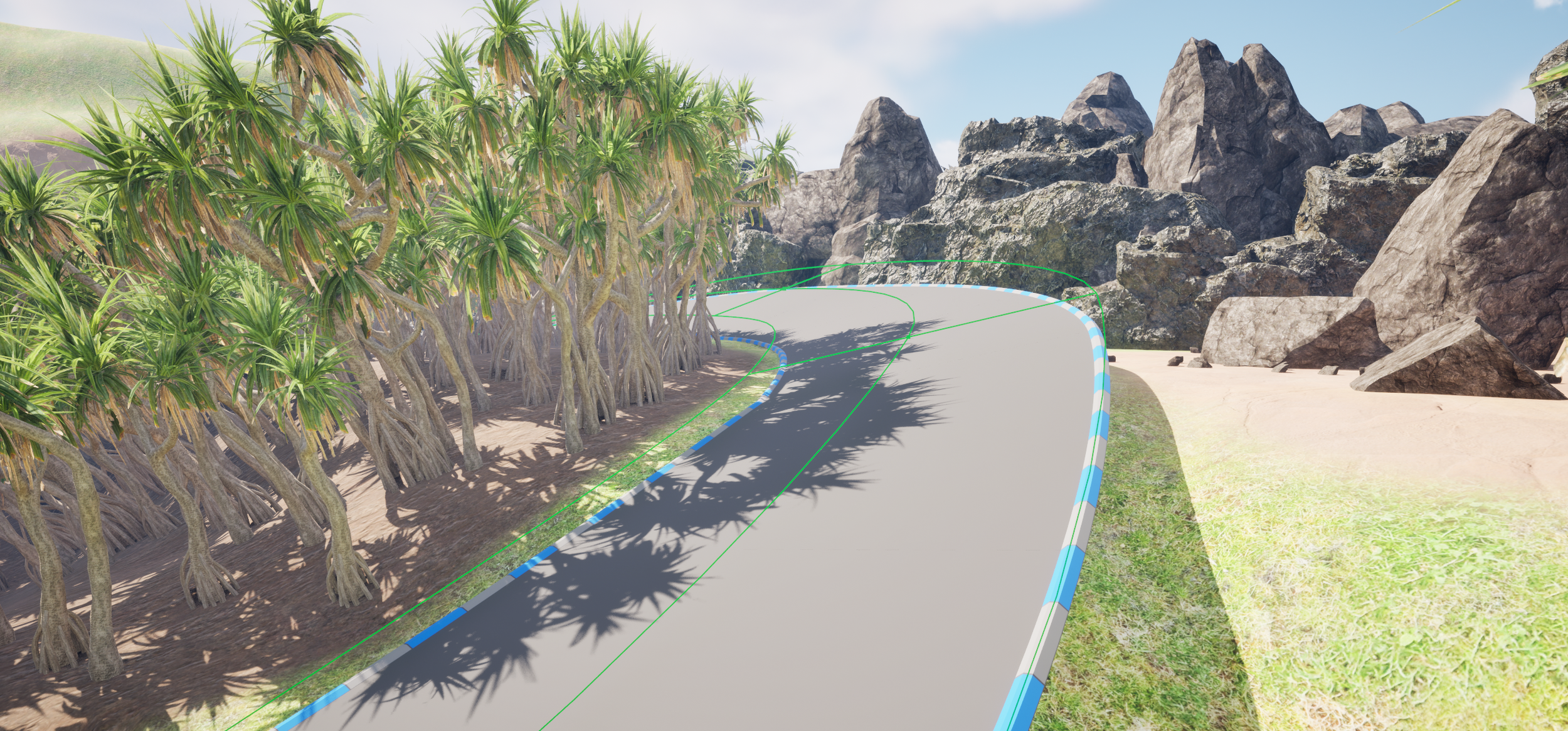
In the beach town track, many of the corners are sharp and squared off.
Forest Track
Want to know more about the design process for each track?
I have done Level Design for other types of games – namely a platform game and a life simulation game. However, there is one genre of game that I had not done any kind of Level Design for, and that is the genre of racing games.
Racing games are interesting because you must approach them in a fundamentally different way than other genres. The player’s goal is literally to spend as little time as possible navigating through the space you’ve laid out for them. As a designer, your goal is to make the player feel fast while allowing them to experience each section at a time. Considering all of that, I set out to create the first of two tracks in this project.
First, I decided on two different general themes for the two different tracks. The first would be a Grand Prix style course set in a forested valley.
The second would be a Street Circuit set in a beachside town that uses the town’s streets as the layout of the course. These two themes felt distinct enough from each other to justify creating both, but similar enough to be recognizable as part of the same project. I also wanted to distinguish between the two tracks in terms of difficulty. The forested valley course would be a moderately easy course, while the beach town track would be more challenging.
Before starting work on the first track, I drew out its layout on paper. I did this slowly and carefully, because I had specific ideas for scenery compositions that I wanted to expose the player to as they navigated through the course. I also included crude drawings of what these compositions would look like from the player’s perspective.

Beach Town Track
Just like many Grand Prix tracks, the track ends with a long main straight.
It’s important for the player to have some amount of time for a “mental reset” between laps, as often racing games are very mentally taxing.
I began the design for the second track in a similar way to the first.
I drew its layout on paper and began to consider what types of scenic compositions I wanted the player to experience. As I was drawing this track out on paper, I was acutely aware of how the design of the course would translate to difficulty. The corners on this course would frequently be squared off as opposed to being gently rounded like in the forest track. Being a street circuit set in a beach town, I really wanted to sell the idea that the player was driving around the actual streets of a neighborhood near a sandy coastline. This means I would need to create intersections and decide on the path that the actual racecourse takes through them.

It was important to me that, for this relatively easy track, the player would be able to drive at full speed for considerably long periods of time throughout the track and limit the number of critical braking points the player needs to hit precisely.
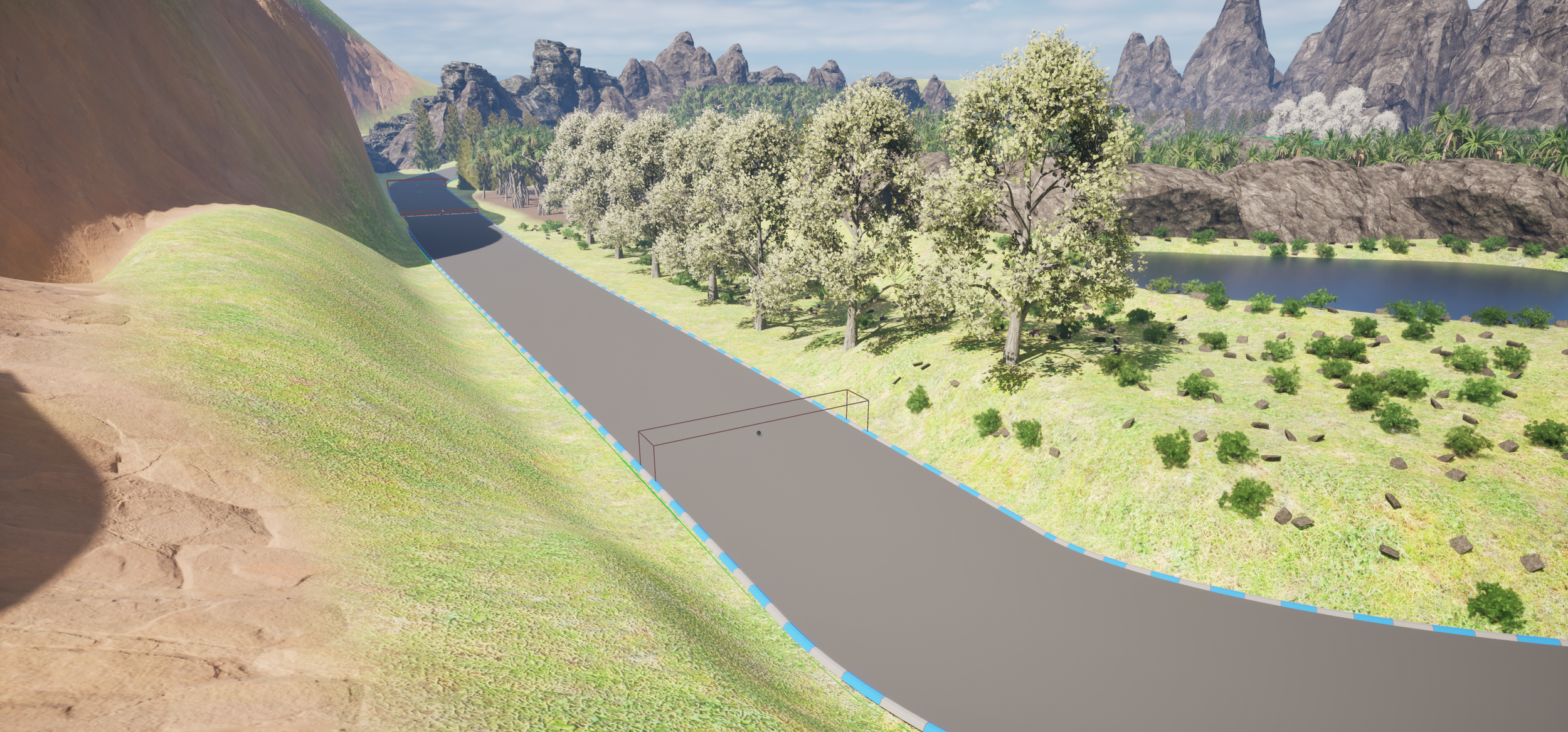
A long right turn up a gentle incline, which comes to its apex before a downhill run into turn 2.
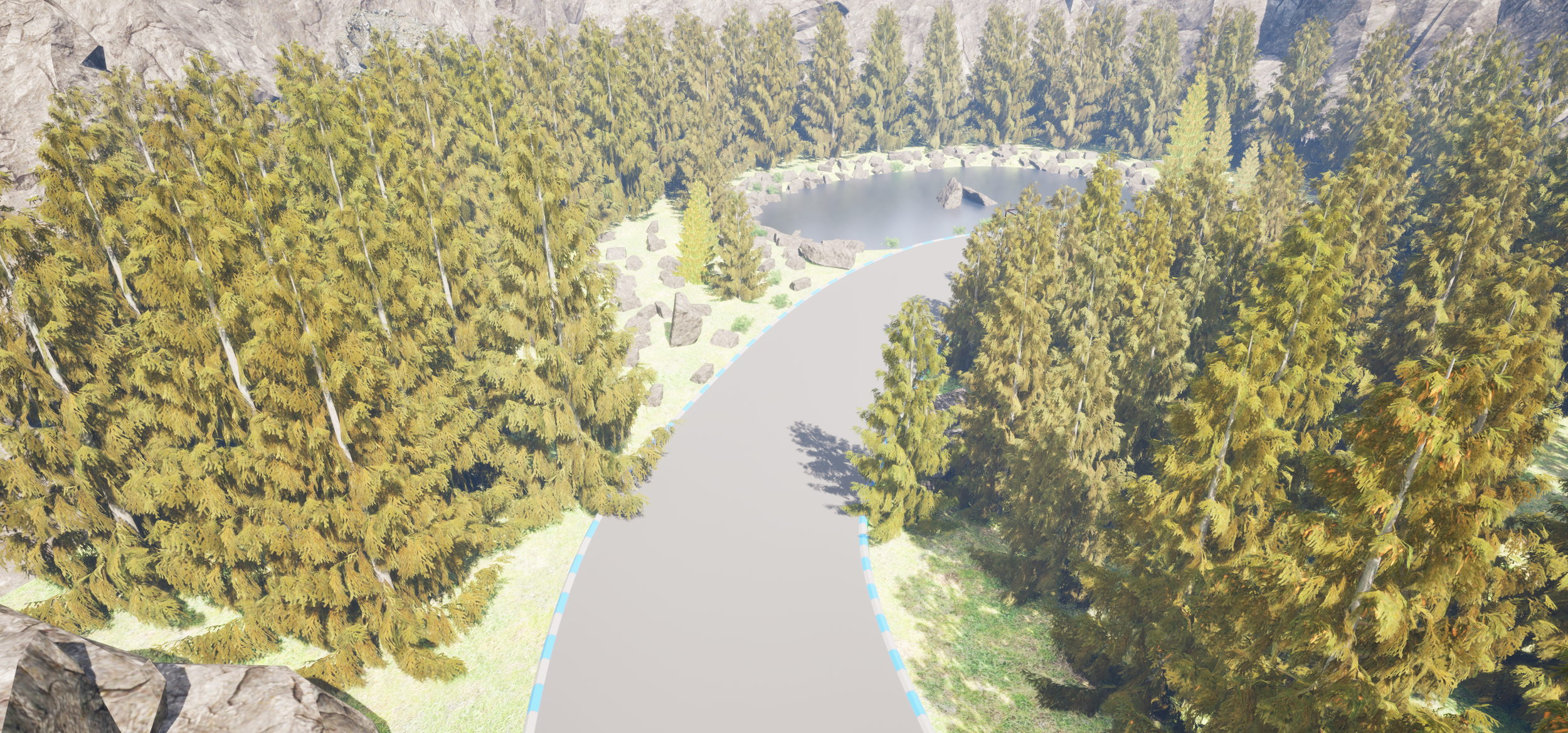
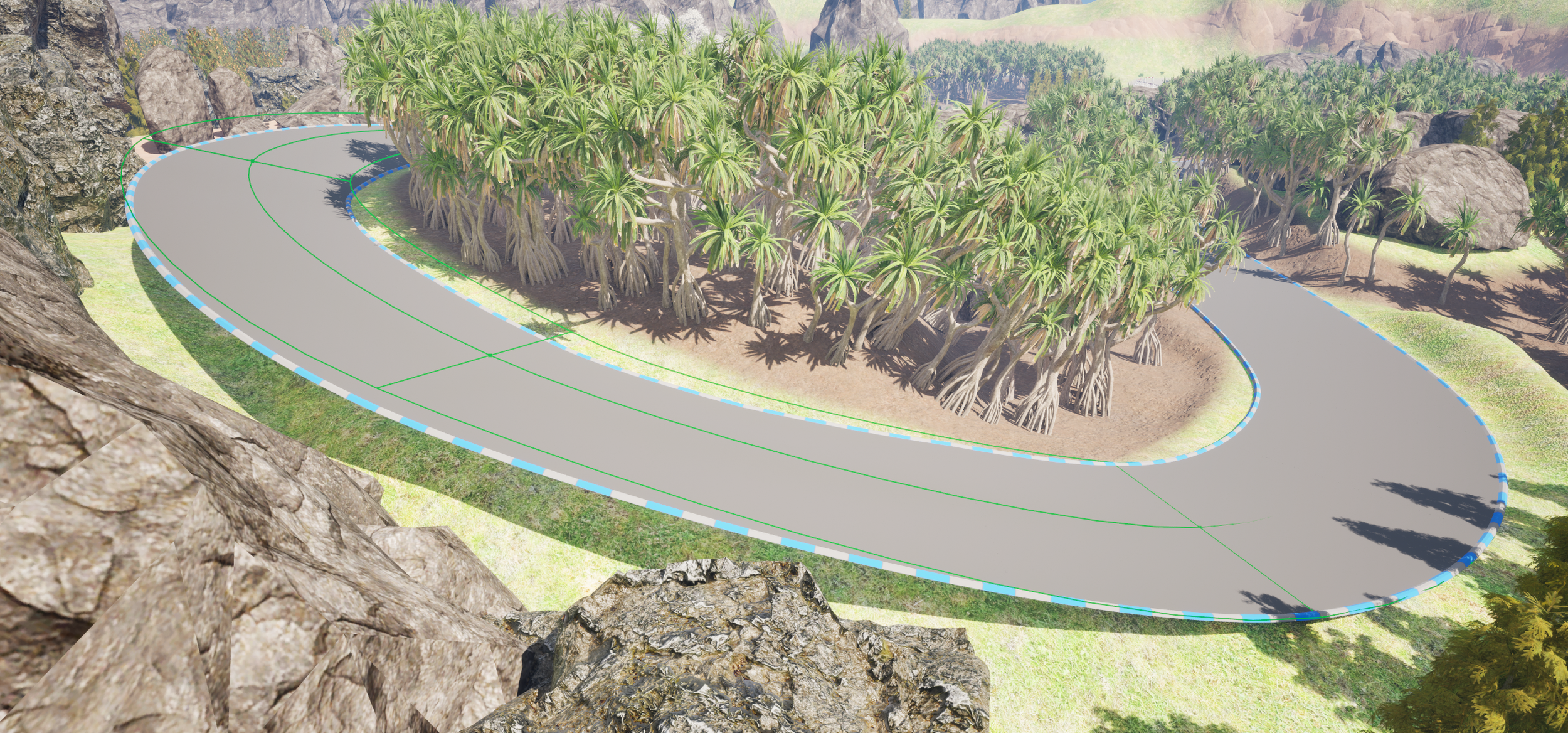
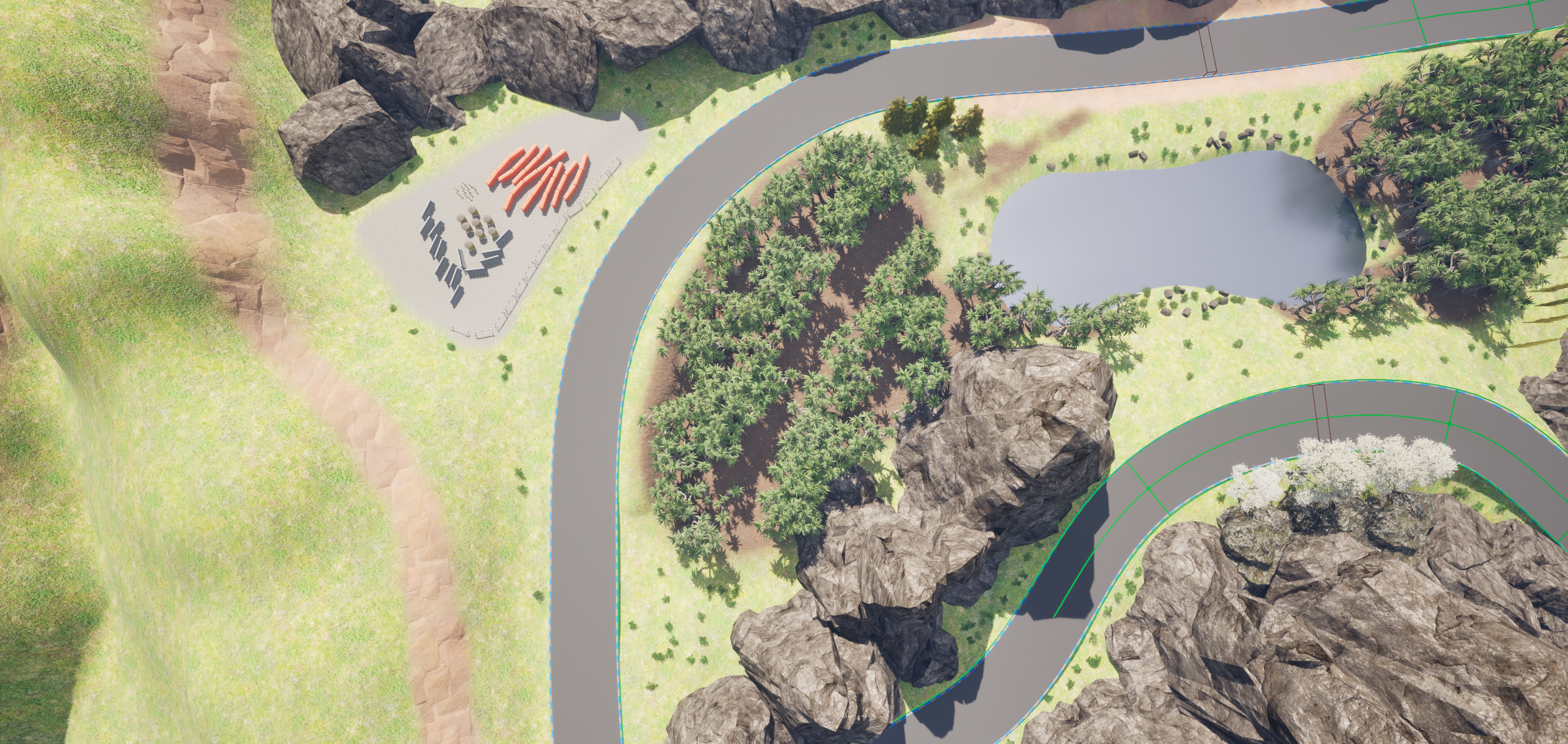
A near-180-degree right turn in front of a small pond surrounded by trees; the player needs to brake going into this turn.
At the top of a gradual incline, this left turn is banked inwards and reveals the rest of the landscape.
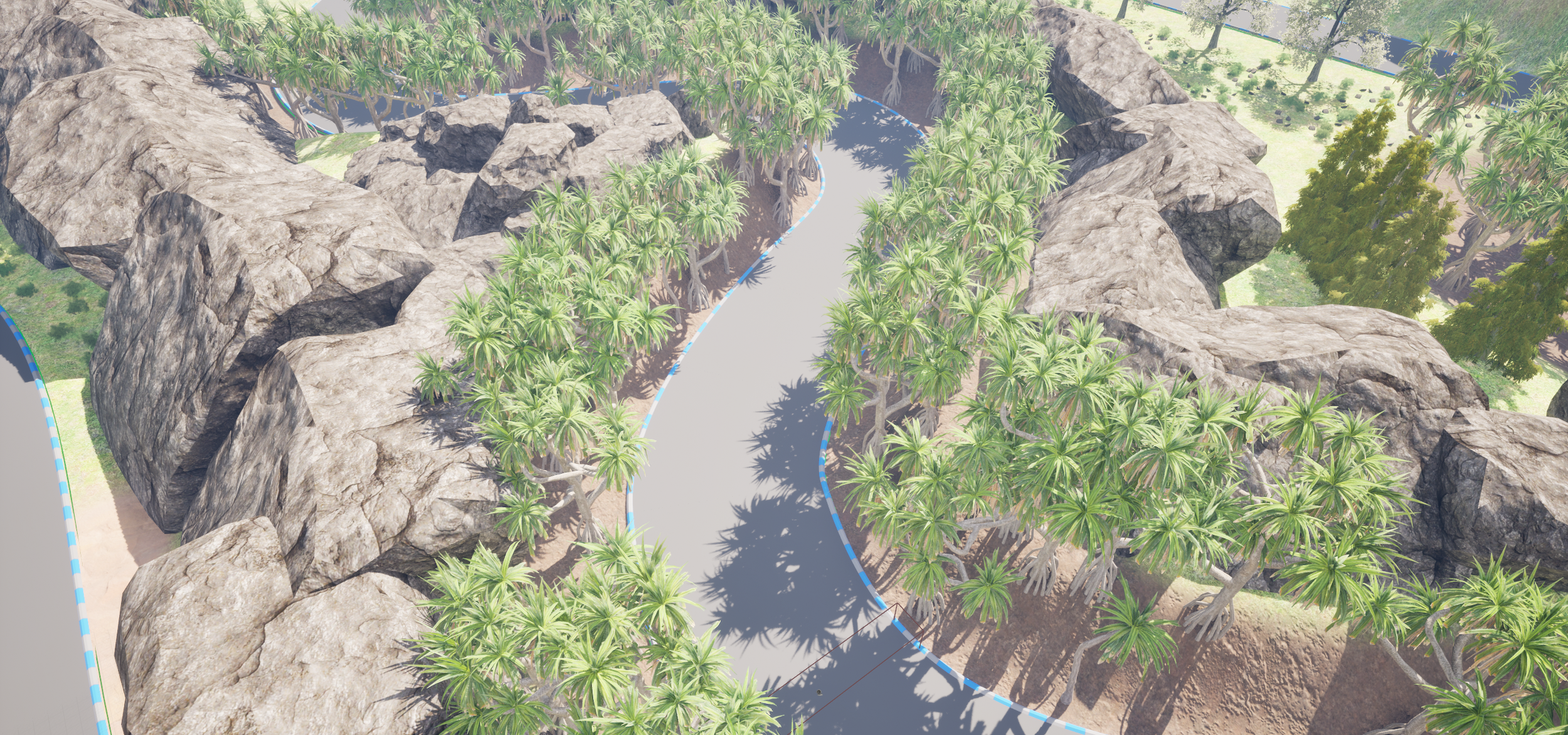
The turn maintains its radius into a downhill slope towards a tighter section enclosed by cliffs and steep slopes right before turn 5.
A slight right the player needs to be aligned correctly for to drive straight through, with room for forgiveness.
A more substantial left turn set just before a tight U-turn, where the player needs to hold the brake to slow down enough.
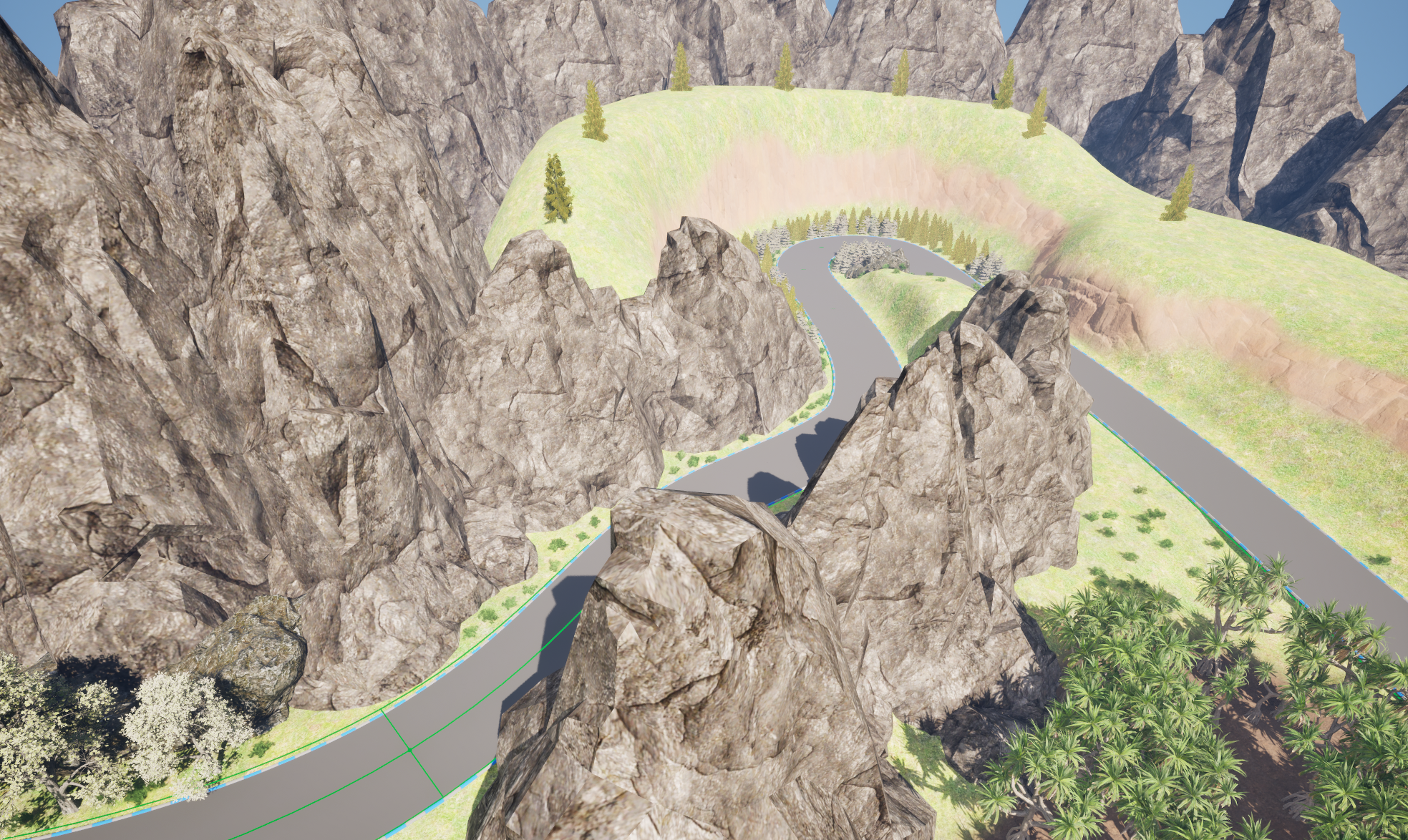
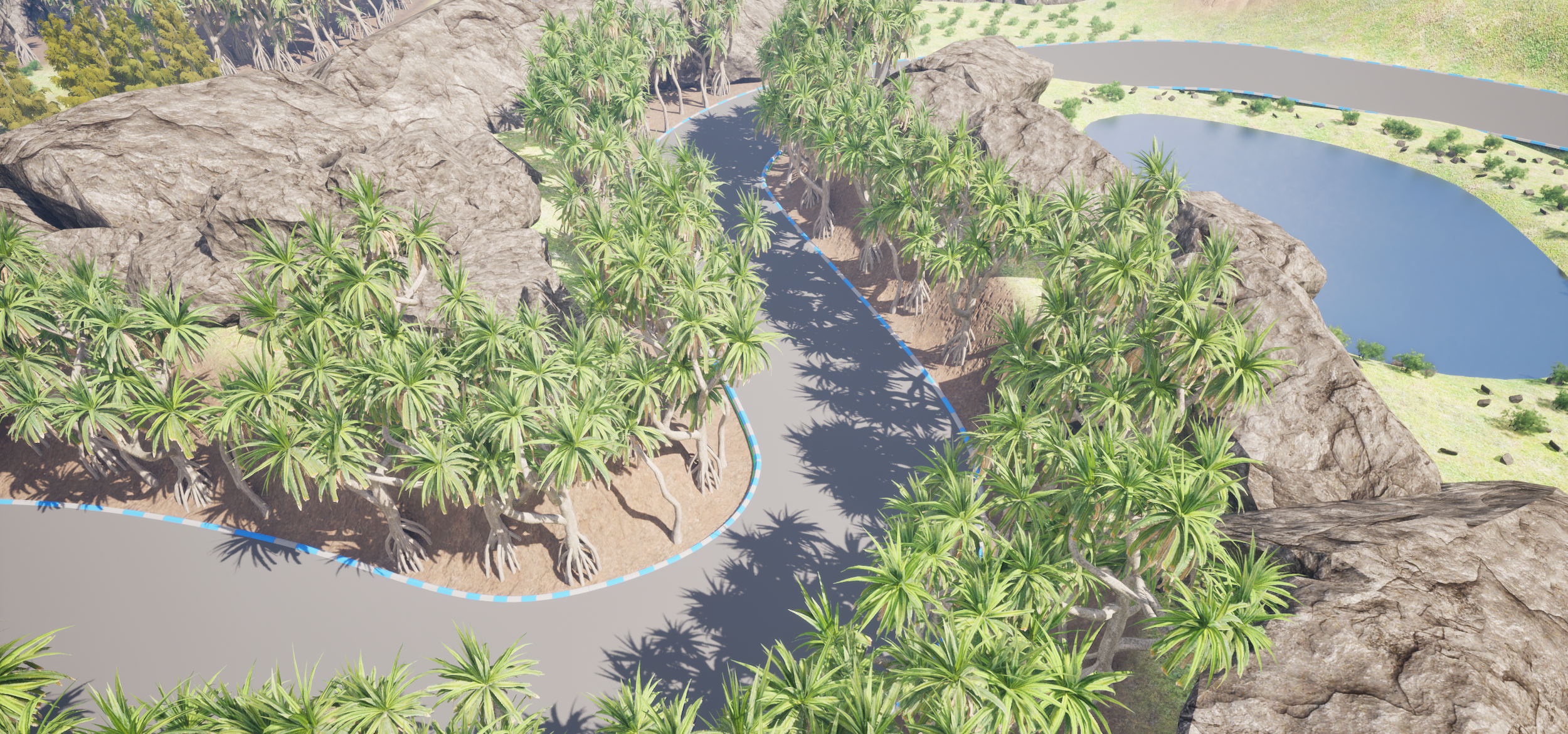
A right U-turn surrounded by tight scenery, where the player must be aware of their braking and acceleration points before and after the turn.
A long sweeping right hand turn, allowing the player again to drive flat-out for a substantial length of time.
A banked left turn at the top of an incline. The radius of the turn is kept constant, but the slope makes it challenging to hold the optimal line.
A continuation of the banked left turn 9, eventually levelling out into a short straight before another right turn.
A medium radius corner where the player needs to be aware of speed control. The first turn in a series of corners where speed control is important.
Another medium radius corner to the left, but now the player is already at a much slower speed. The player approaches this corner differently than turn 11.
The beginning of a changing-radius corner to round out the lap. At this point, the player can begin driving flat out again.
A banked right turn back to the main straight. As this is the last corner, the player ideally wants to accelerate as early as possible here.
The first area I focused on was the area that contained turn 2.
After a gradual downhill slope at a speed of 200 kilometers per hour, the player enters a somewhat circular area filled with trees and a lake in the middle. To truly sell the player on the idea that they were cutting through the forest, I brought the trees close to the track both where the player enters the glade, and where they exit it. This also helps the reveal of the clearing at turn 3, where the scenery opens to the right of the track alongside a tall cliff on the left.
The second area I focused on was the tight U-turn at turn 7.
For any spots on the track where the player must brake considerably, I consciously bring the scenery close to the player. It’s subtle, but this shift in how much space exists around the player subconsciously triggers them to be more alert and aware. For turn 7, the scenery comes in tight once again like it does for turn 2 and opens once the player is free to accelerate as fast as they want.
Turns 9 and 10 slowly meshed into becoming one long tilted turn of a uniform radius, and it was a pain point in the design process.
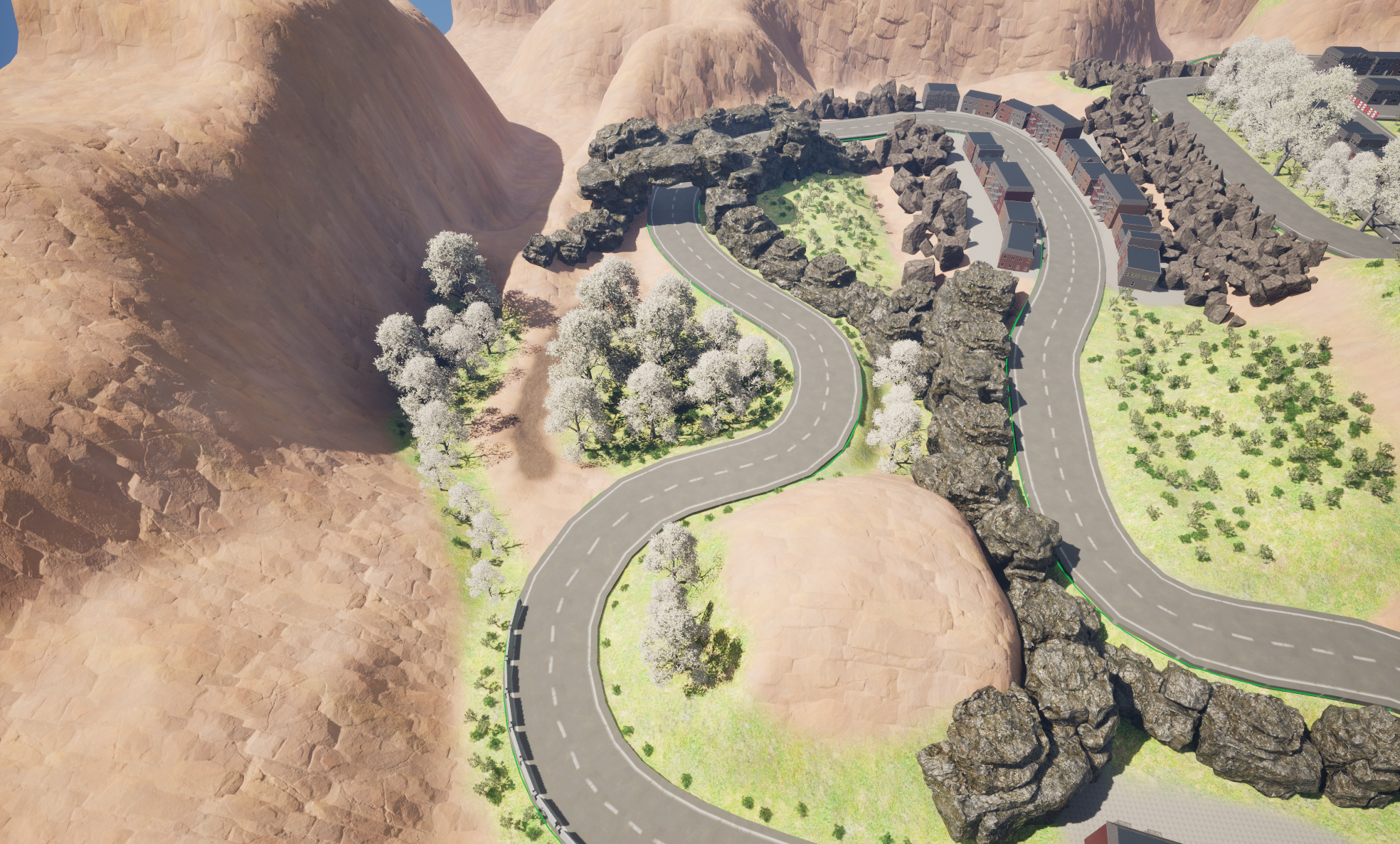
I was trying to make this turn fun to drive around as the player sped down a straightaway directly towards the cliff, only to find traction in their brakes and complete the turn to the left just before reaching the rock wall. Creating a uniform radius corner that started at an incline, became level, and eventually came back down was a challenge. It was a matter of carefully changing the position and rotation of the spline control points, testing it, and repeating that process until it felt smooth.
Finally, the chicane that goes through turns 11, 12, and 13.
My biggest fear is that these corners would feel generic, similar to each other, and boring. However, the player is approaching turn 11 with quite a bit of speed and needs to slow down. Even if this is a flat, uniform-radius corner, the next turn could be as well, and they would feel meaningfully different because of the player’s lower speed entering turn 12. This is a point on the track where the skill of speed control is tested, and it doesn’t effectively get tested anywhere else on the track.
Finally, as a small addition to this track, I added a shortcut.
This is a risk-reward decision the player has to make. The shortcut can save time if done correctly, but not very much, and if it goes poorly, it results in a huge time loss.
This track would demand much more attention to acceleration and braking zones from the player and would also change elevation more frequently.
A tight left turn at the base of a considerably steep incline. This long uphill straight is inspired by rollercoasters that have a long, suspenseful chain lift to bring the coaster up to its highest point.
A slight left veering at an intersection. The track levels out here, so the player needs to be aware of traction as they try to adjust. If they’re not careful, the player may catch some air and lose grip while trying to realign for the next corner.
A left turn after a slight downhill slope. It’s easy to misjudge the braking point for this turn due to the slightly sloped nature of the runup.
A 90-degree left turn after a bit of a straight driving. This corner is practically symmetrical about its apex, so the player can take it cleanly if they’re focused.
This turn was originally going to be a roundabout, but I instead made turn 5 a simpler left turn at a basic intersection. The reason I made this change was because a simple left turn flowed nicely out of turn 4 and allowed the player to potentially tackle both corners with one continuous turn if driven properly.
The infamous downhill turn 6 was a pain point in the design process for a while and took a lot of time to properly smooth out. This 180-degree downhill right turn requires extreme caution from the player, as travelling even slightly too fast at any point can cause the car to fly right off.
Turn 7 is the first part of a small uphill chicane.
Turn 8 rounds out this short chicane with a quick kick left. The player can drive through these corners straight without turning but must then be aware that if they drive like this, they will have much more speed entering turn 9, which could be problematic if they don’t account for the braking distance they need.
A right turn before a straightaway. Turn 10 later got smoothed out so as to be basically non-existent, creating a straightaway between turns 9 and 11. The most important part of turn 9 is that the player comes out of it with as much speed as possible. This is done by holding accelerate as soon as the player can clear the corner with their current speed, which is constantly decreasing from braking into the corner.
Effectively straightaway toward turn 11, allowing the player to build speed again. Speed control is a consistent theme throughout the course.
A left turn just before a gentle downhill section. The player is aided with brake markers on this corner, so over the course of several laps, the player can find a braking point that works best for them.
Turns 12, 13, and 14 did not end up being if they seem in the image. Even still, these three turns take place on a gentle downhill slope, which makes it quite challenging how much space the player needs to make the turn. Slowing down too much wastes time but going too fast may have the player hit a wall or fly off course. This is the ultimate test of the player’s speed control.
This right turn is only about a 60-degree right turn in actuality. After coming out of turn 12 slow, the player has some room to accelerate, but only a small amount before having to control the right turn.
A left turn is similar in nature to turn 12, after which the track finally levels out. This is where the player needs to begin accelerating as early as possible to scream down the main straight and minimize time lost.
Basically, it is a non-existent turn. The player can drive through here flat-out and generate speed down the straight.
This is barely even a turn as it got smoothed into the straightaway.
This is also barely even a turn. Turns 15, 16, and 17 effectively got smoothed into a massive straightaway that helps the course flow smoother between laps. The turn 12-14 section already felt quite climactic in terms of difficulty, so having more difficult turns after that before the end of the lap felt out of place.
My approach to creating this track was quite different from the forest track.
With the forest track, I was primarily concerned with creating a track that all flowed nicely and then built the environment around it. For the beach track, my process was somewhat the reverse, where I started by building the town and then turned it into a racetrack by adding everything a racetrack would need.
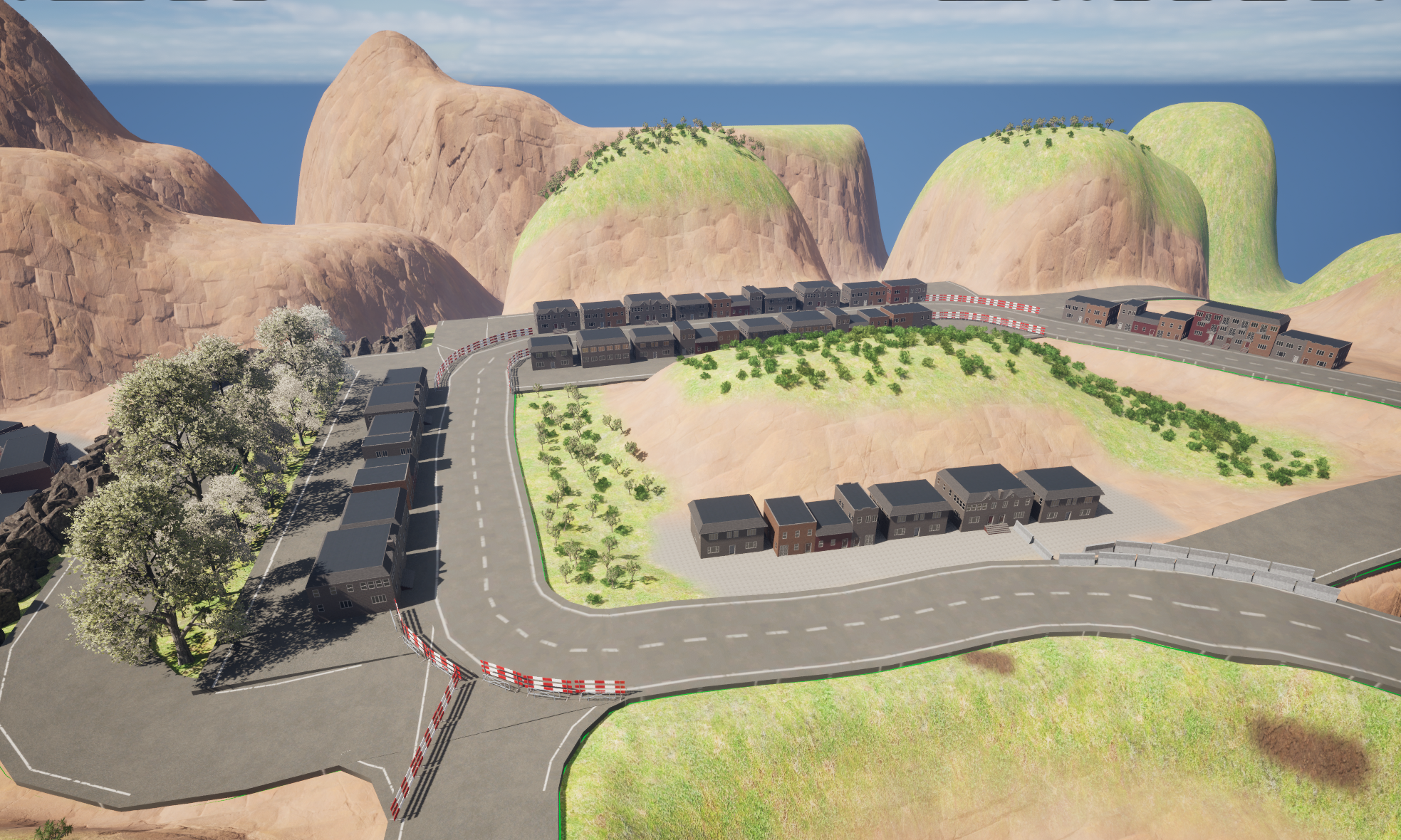
I was very conscious of what the players see as they pass through this section of the course (turns 4 and 5).
Moving quickly down the straightaway between the buildings, the player can start to see the left turn, then they need to break. Down the next straight, they have a row of houses to their right backed by tall trees, and a clearing to the left. This subtlety indicates that another left turn is coming, which it does; the player dives into a left turn. The buildings on the next straight now populate the left side of the track, and the player subconsciously knows to turn right next.
Turns 12, 13, and 14 are different from how I initially drew them out, but they are still substantially challenging corners to drive.
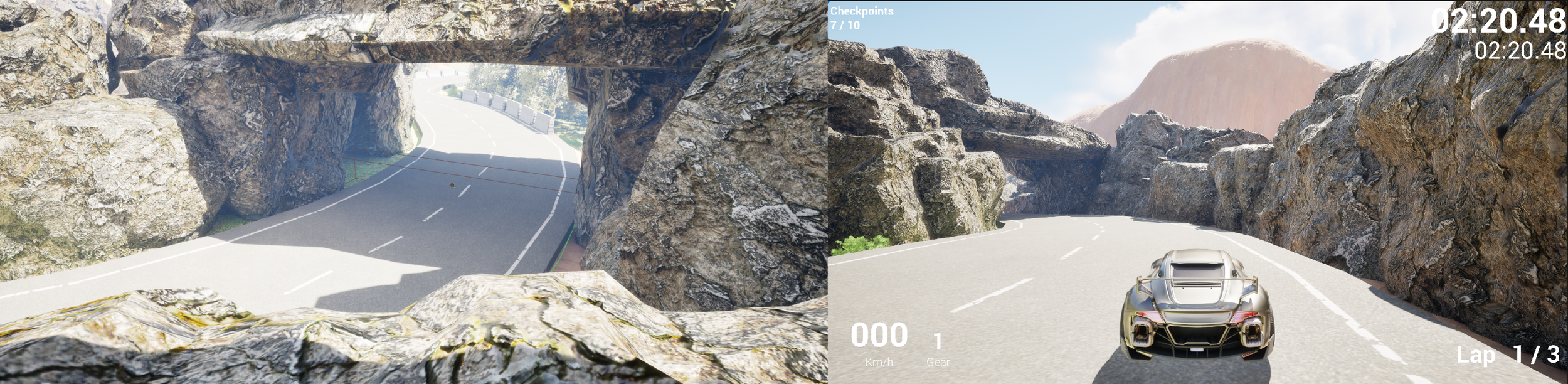
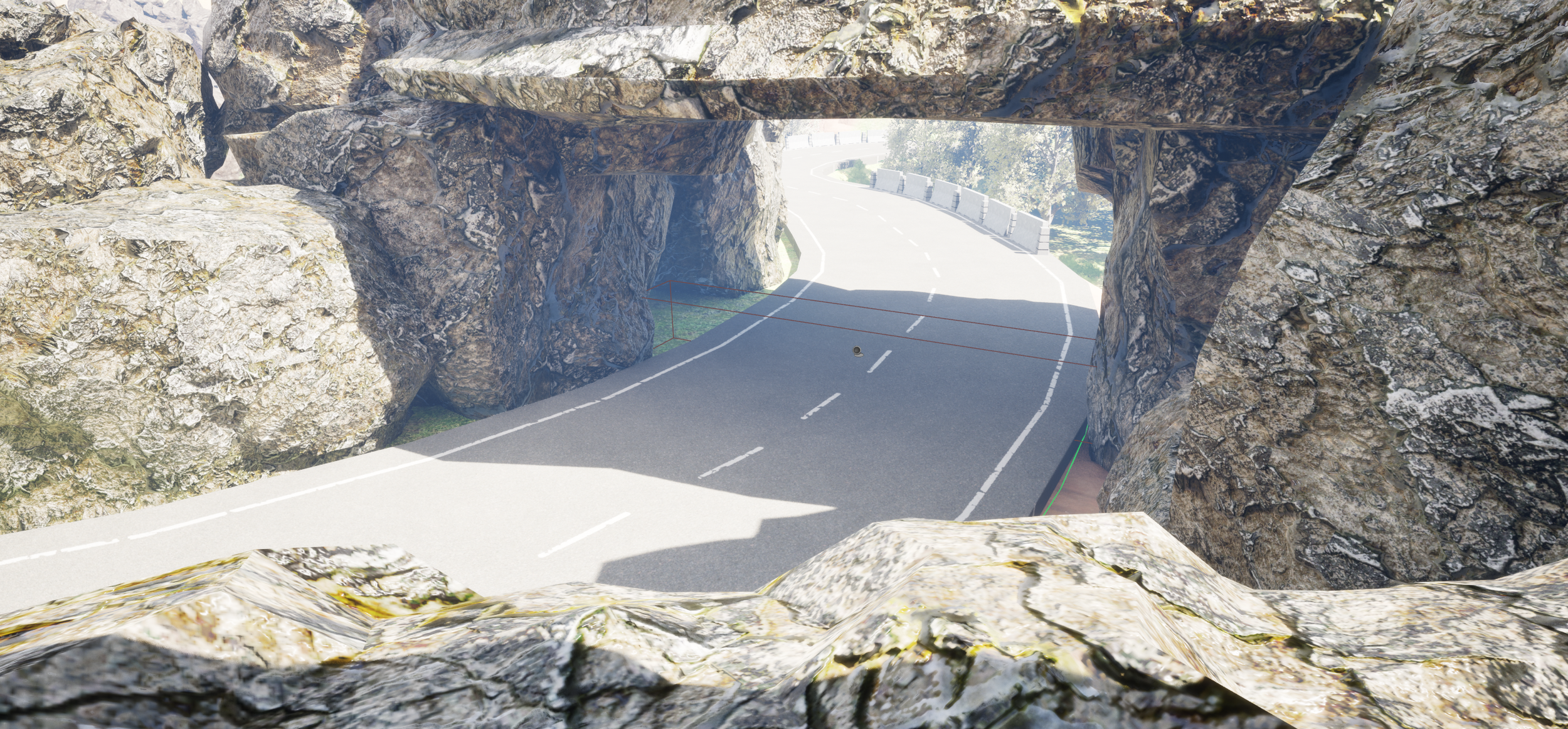
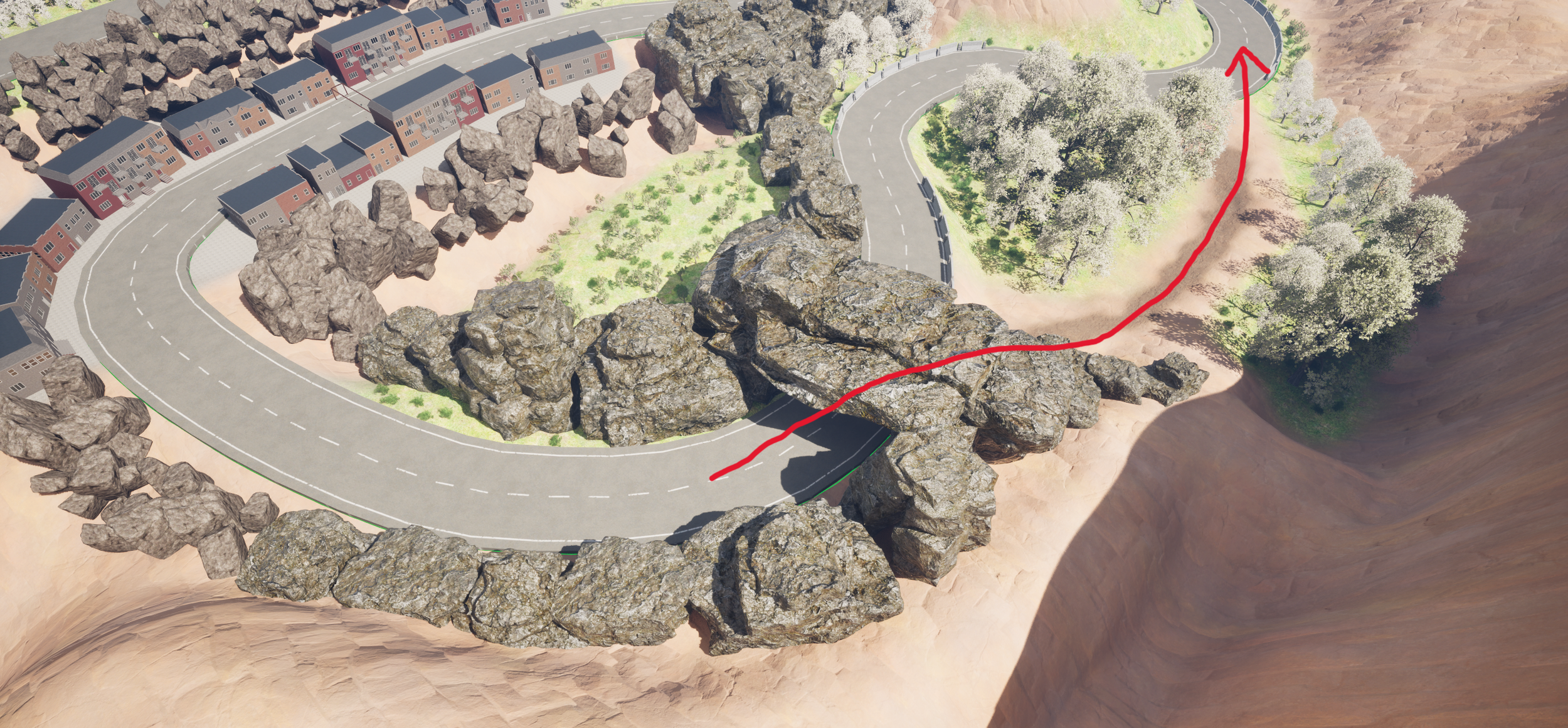
Also, the player drives under a rock formation that suddenly reveals the first part of the chicane as they pass through.
While creating this track, I also had a focus on creating shortcuts.
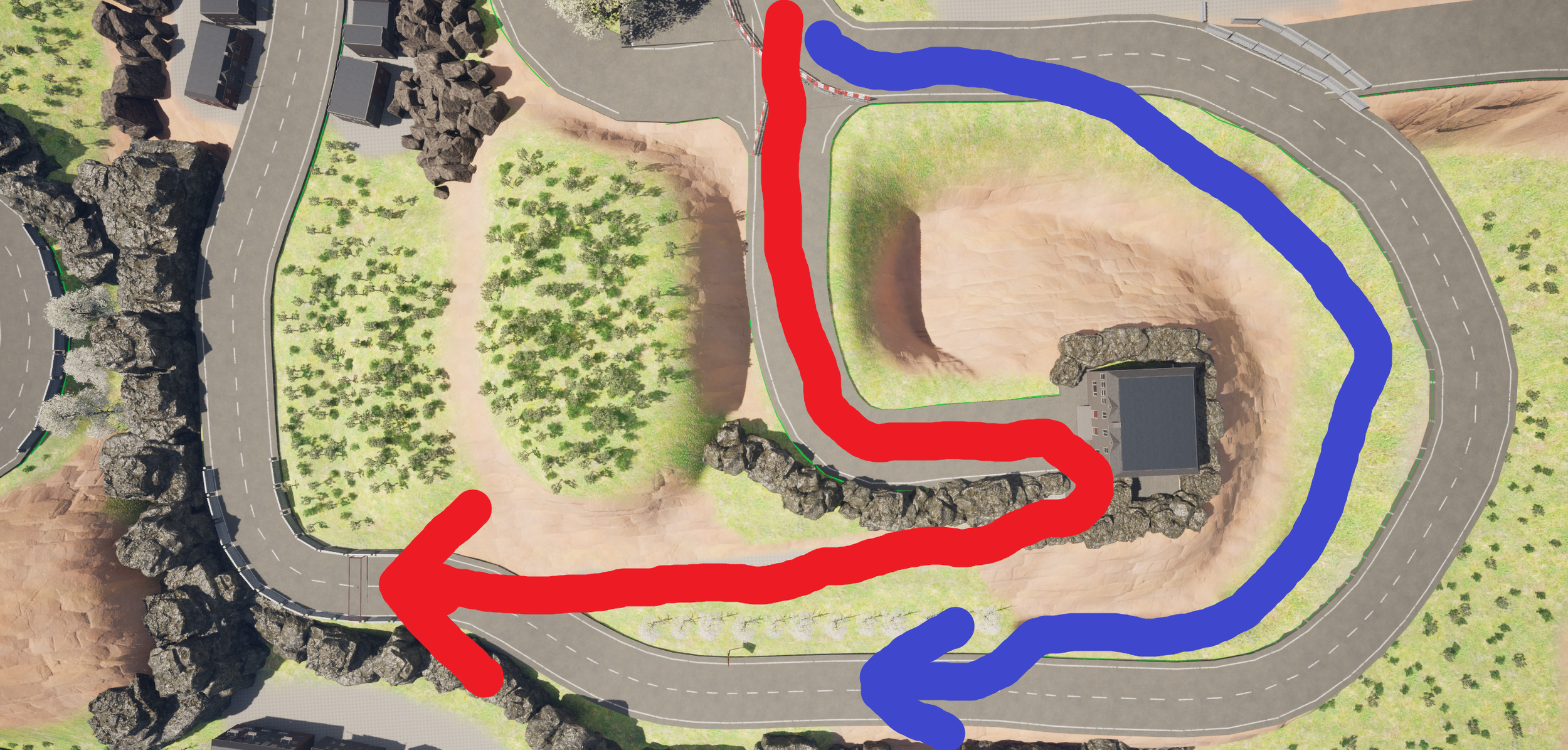
This track contains three shortcuts, up to two of which can be taken per lap. This is because two of the three shortcuts cut off the same turn, so the player must choose to take the main route, or one of two shortcuts. At the big, long downhill turn 6, the player can jump off the road and wallride the inside of the slope. This is risky but it is faster than staying on the road when done correctly.
But there’s another way to go about this shortcut.
If the player observes the gap between the barricades that is barely wide enough to fit their car through, they can drive to the house on the hill, around the tiny corner, and down the slope. This saves plenty of time if done properly, but the player needs to be extremely cautious about their speed as they jump back onto the track because turn 9 is about to meet them head-on if they aren’t careful.
Both of these shortcuts came to be in similar ways.
For the wallride shortcut, it felt as though it should be one intended way to take the corner becuase of how well it already worked. To disallow the shortcut, I would need to build some preventative measures so that players can’t use it, and this would punish players for trying to think creatively about how best to approach the turn. Instead, I want players to challenge themselves to think outside the racetrack in order to find ways to reduce their time. As for the house-on-the-hill shortcut, this would also be discovered by a player who is curious enough to explore the small gap in the barriers encouraging you to turn left instead.
The downhill chicane at the end of the course also has a hidden shortcut.
However, the ground drops away from the track, so without being curious, a player would not find it. There’s a gap between the rocks holding up the big stone arch and the barrier on the right side that the player can dive through to access this shortcut. Once they’re off track, they need to maintain speed and align themselves with turn 14 properly, or they won’t be able to get back up, and they’ll end up having to drive through turns 12 to 14 normally.
This was a 10-week project, and in that time, I learned a lot about Level Design in the space of racing games. First of all, I learned;
How to work with splines in Unreal
How to use the foliage tool to populate barren exterior areas
How to better use the landscape tools to shape the terrain, and how that interacts with splines
But those are Unreal Engine based skills. They’re all useful, but more importantly, I learned;
What goes into a composition to be seen by players “at speed”
How to pace naturally fast-paced gameplay using space and density of scenery
How to translate an initial vision of a project from paper to project
How to design challenge for gameplay that is designed to be continuous and repetitive (fluid laps of a racetrack) as opposed to having discrete levels and being various (in the case of platforming levels, for example)
Before this project, I had always wanted to do any kind of level design for a racing game, but I never knew where or how to start. I figured using Unreal Engine was a good call - this turned out to be true. From there, I started by doing what I felt was right - drawing out the tracks on paper.
The creative process can look very different for different projects, and this is something I learned too. Inspiration can come from weird places. I had visions in my mind about how certain parts of the track would look; I just had one semester to make it all in the engine. That’s another thing I learned:
How to plan and execute tasks on a two-week sprint basis
How to plan out buffer time within a work plan in case of falling behind