Fast Break - A Tabletop Basketball Game
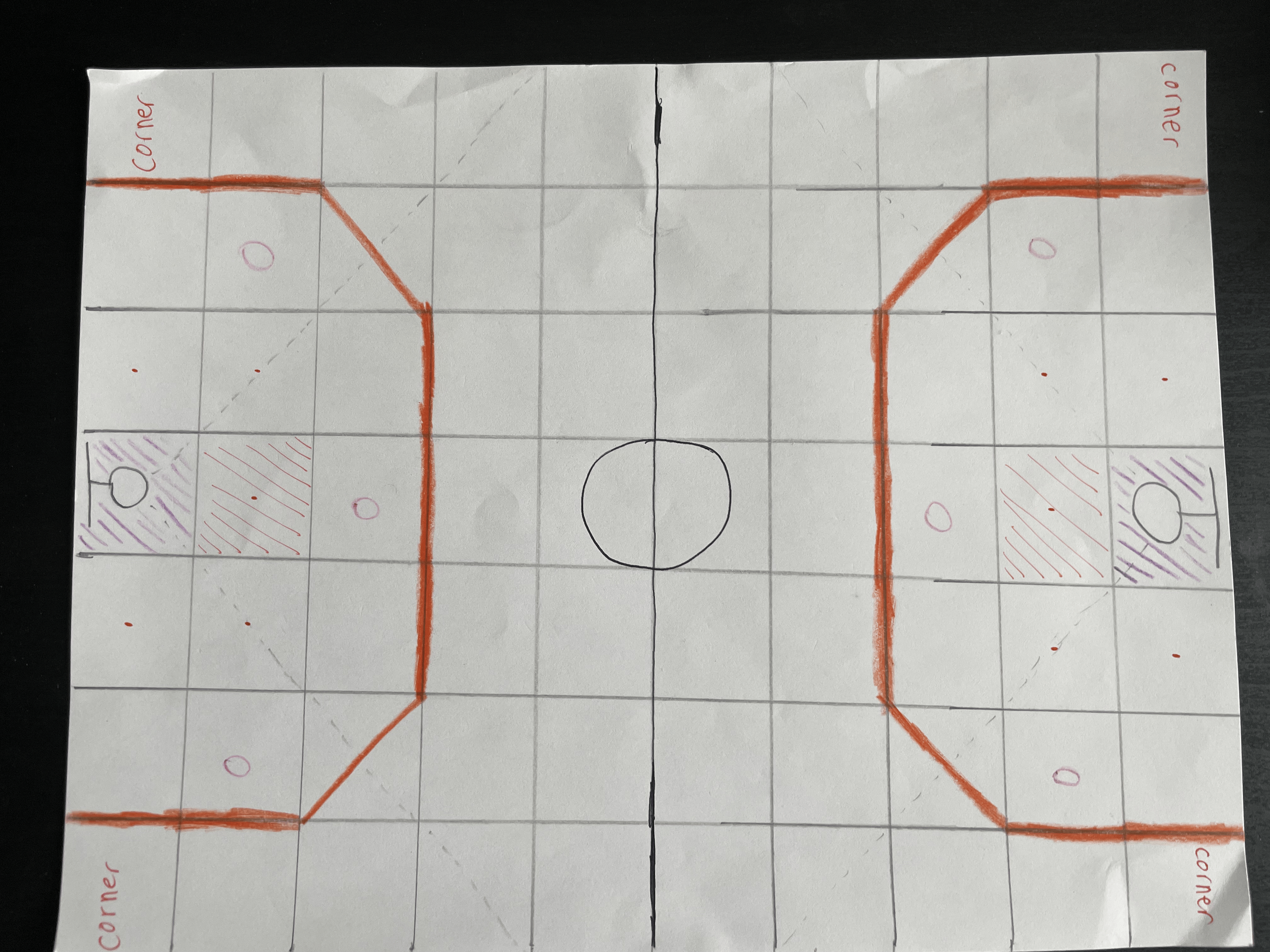
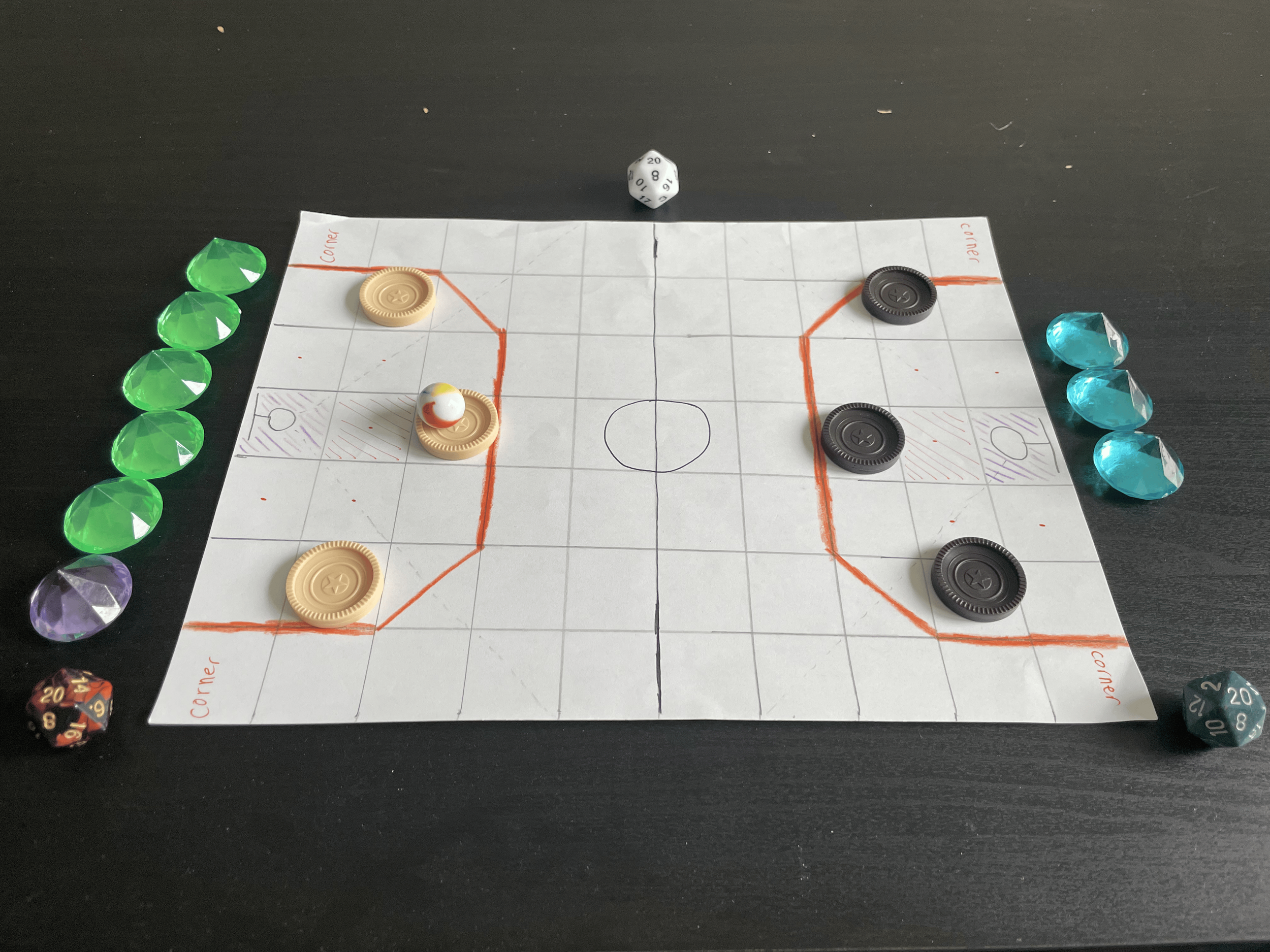
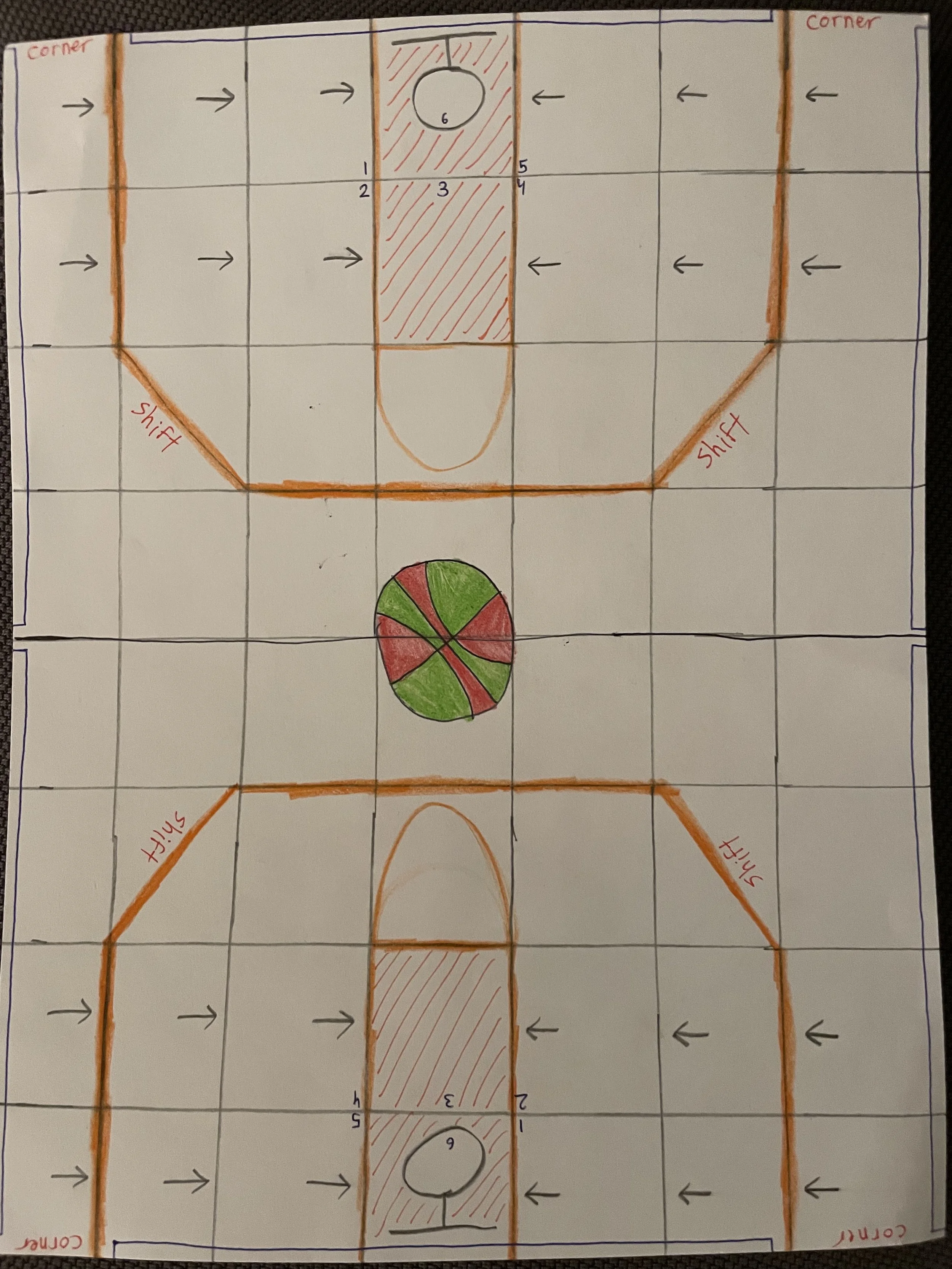
Fast Break started as a simple Chess-like 3-on-3 tabletop game based on pickup Basketball. The entire first prototype fit nicely on a coffee table. Over time though, this game grew into a larger, greater form enjoyed by many students at DigiPen. The board is a 7x10 rectangle with a hoop space on either side, starting positions for tokens, a 3-point arc, a center line, and marked corner spaces.
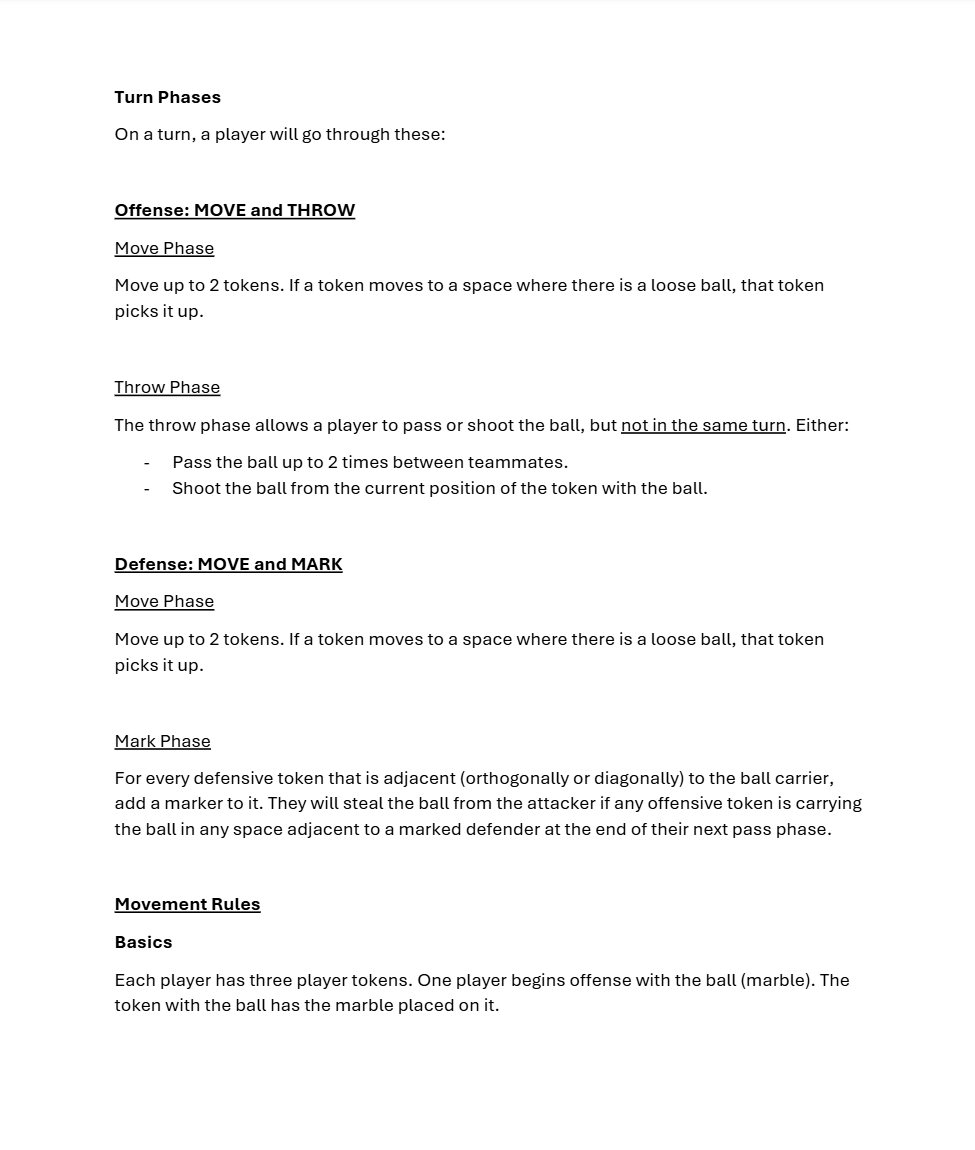
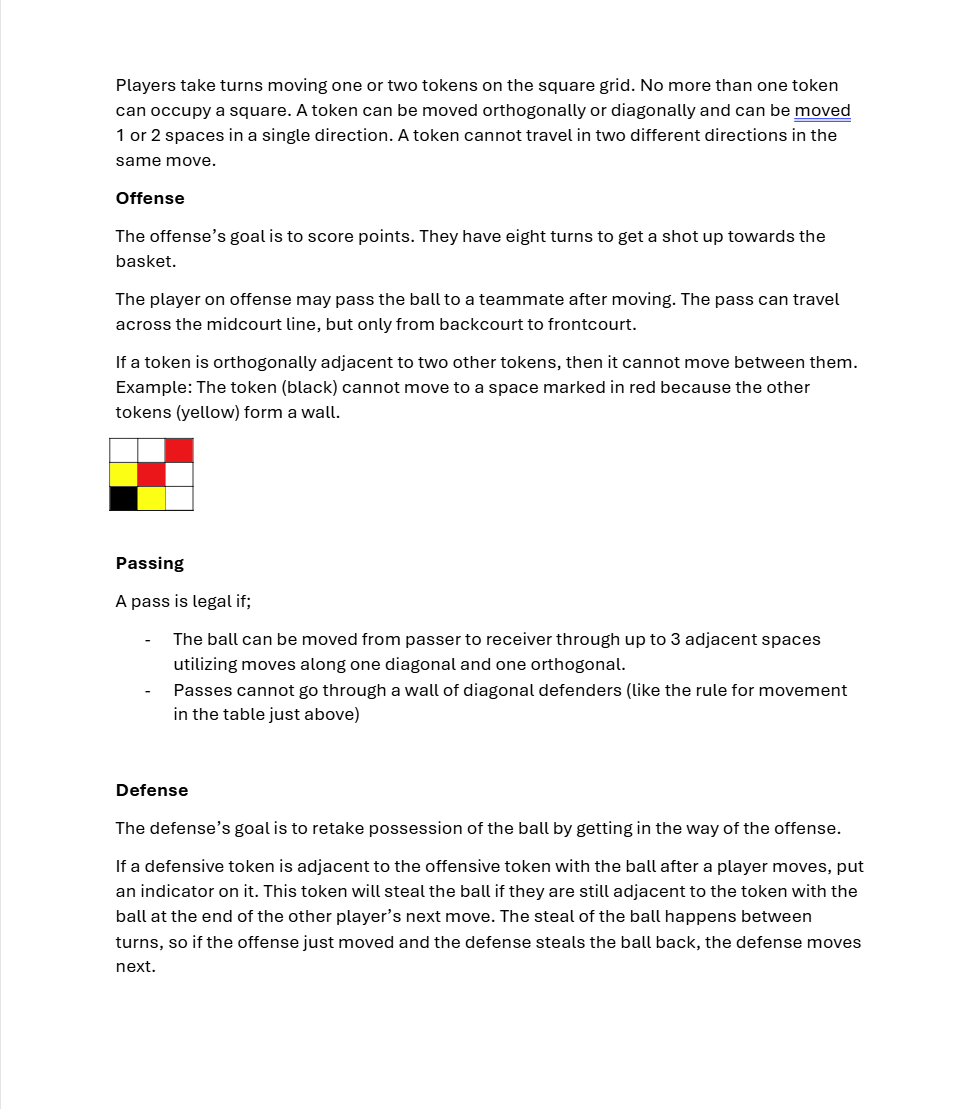
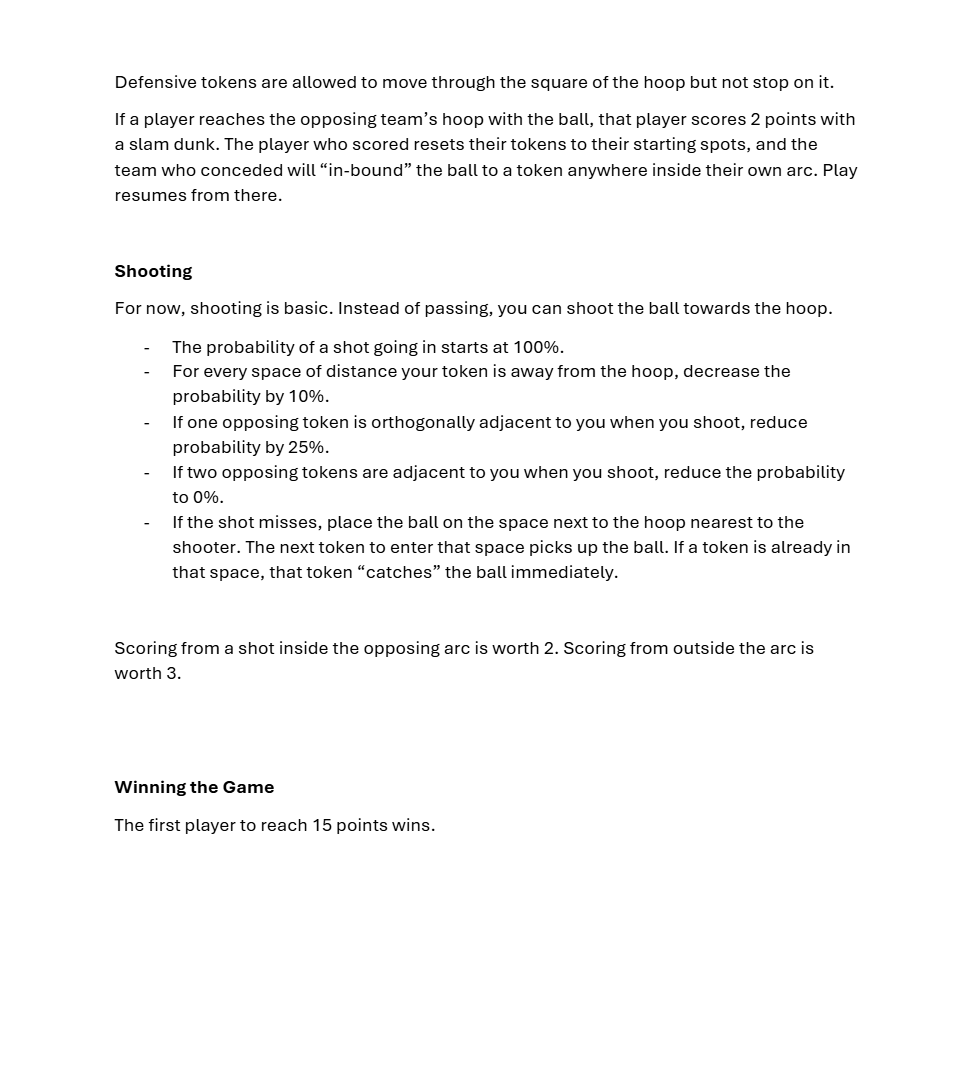
The first set of rules was designed to be simple. However, there were definitely plenty of things to fix.
PROBLEM 1: Defense was way too challenging.
Being able to move and shoot in the same turn was nearly impossible to defend against.
Also being able to pass the ball twice in the same turn made it difficult for the defense to “read” an offense, and this also contributed to the offense/defense imbalance.
PROBLEM 2: Shooting/Probability of Success.
First of all, the way I described how to calculate the probability of a shot going in was confusing. I was going to have players use d20s to see if their shots go in, so describing the probabilities as actual percentages that have to be converted to dice rolls was unnecessary.
Also, a careful reading of the success probability rules will tell you that a shot from just beyond the half-court line has a 50% chance of going in. This was a huge mistake on my part, and this needed immediate fixing. This is why we playtest.
I addressed these problems quickly with some revised rules. The first major change was this:
At first, the offense would;
Move Phase
Throw Phase (Pass OR Shoot)
In the revised rules, the offense would;
Move Phase
Pass Phase
OR
Spend this whole turn shooting
Unfortunately, this swung the pendulum too far the other way, and now it was suddenly much too easy to defend. Regardless of where and how the offense moved, they wouldn’t be able to get a token into a spot where no defender was adjacent to make a shot more challenging. The only way to reliably score was to move all the way to the hoop for an automatic “dunk”. I didn’t even playtest this revision with other people, I quickly figured this out by testing it alone.
Knowing this, the correct balance of offense and defense would be somewhere in the middle of these two rules;
1) Letting the offense move and shoot in the same turn (too easy to score)
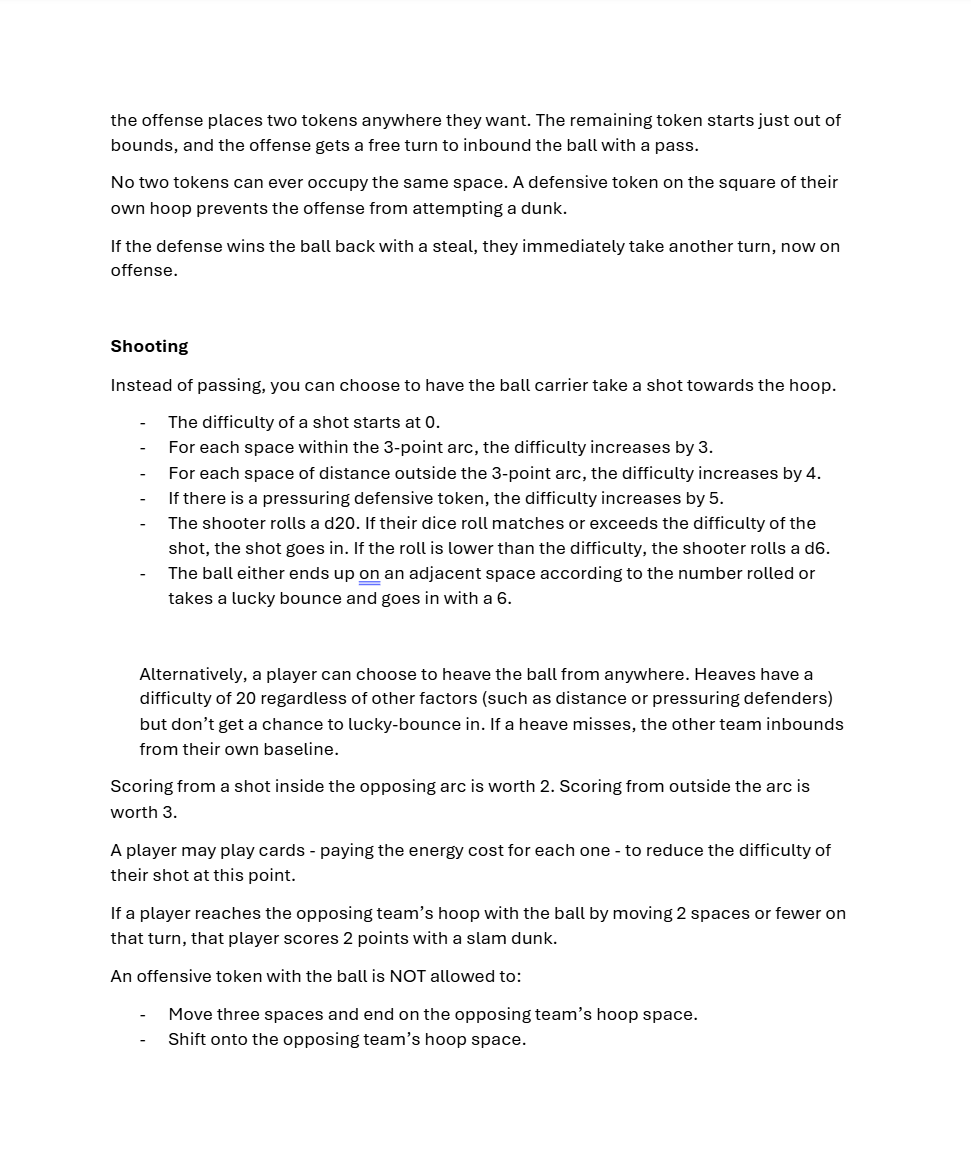
2) Forcing the offense to spend one whole turn on just shooting with no moving beforehand (too hard to score)
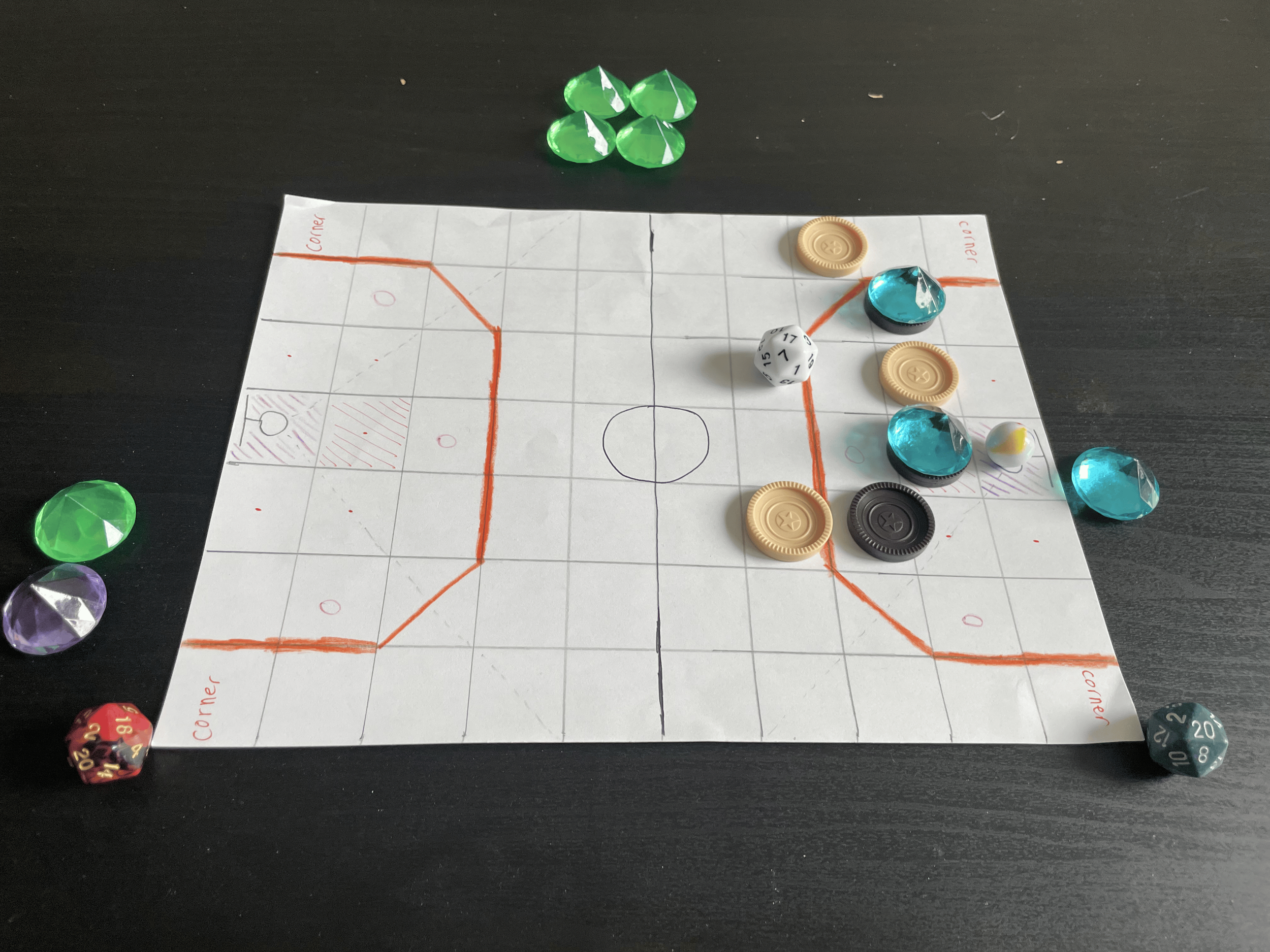
Gameplay photograph. Light team scores on their 4th of 6 turns on offense after a roll of 17, hence the green tokens and d20 dice. Two marked Dark team defenders weren’t able to make a stop.
Note the use of d20s for both shooting and for counting score. The Light team’s d20 is set at “2” as they just scored 2 points. The d20 for the Dark team is on “20” because the game is played to 15, so “20” indicates they haven’t scored yet.
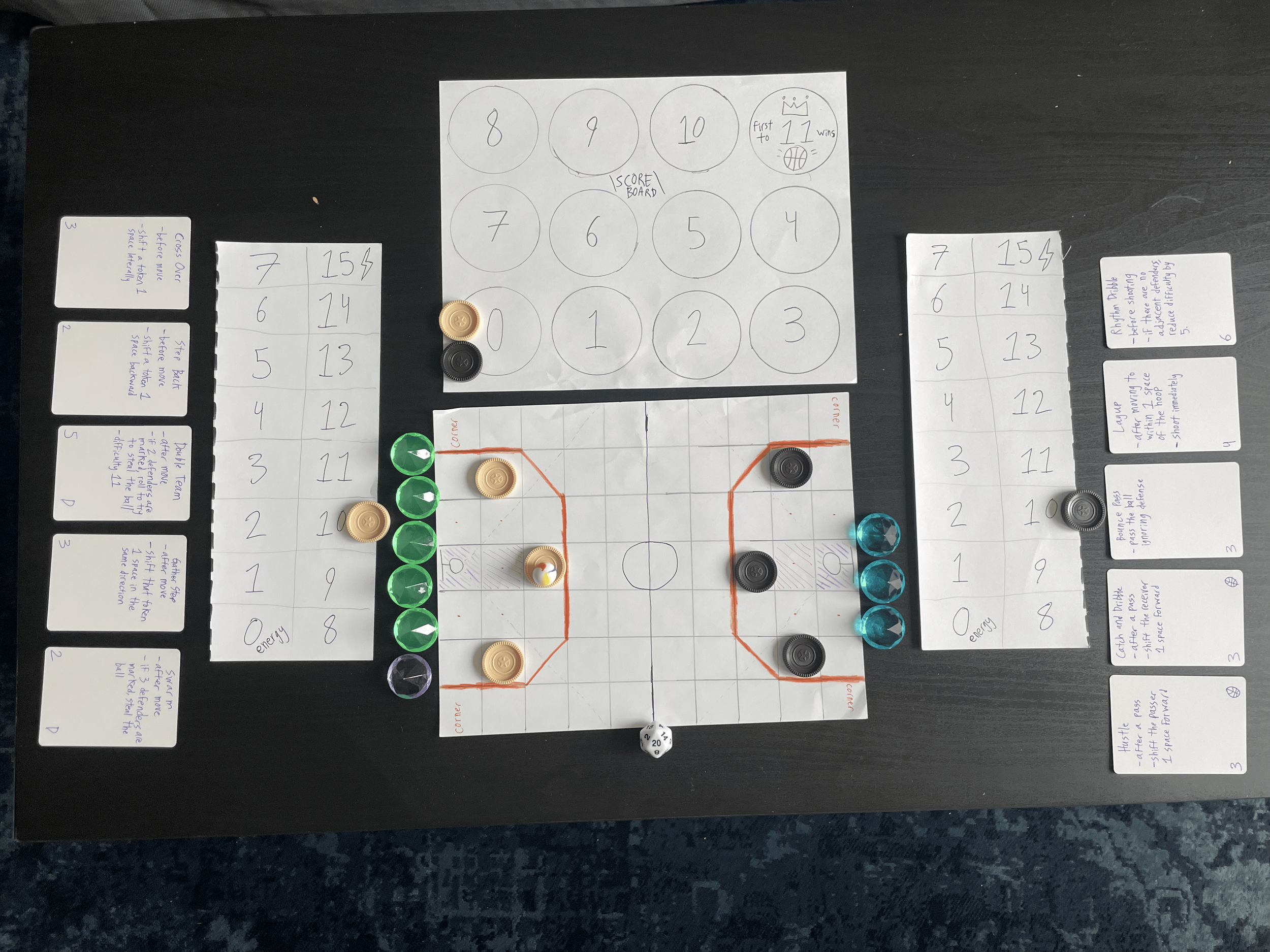
At first, certain cards could only be used to SHIFT tokens;
1) STRICTLY BEFORE a MOVE or
2) STRICTLY AFTER a MOVE.
This meant there was a clear procedure of “Before-Shift”, “Move”, “After-Shift”. I figured this would allow me to make a larger variety of card types. But that was unnecessary.
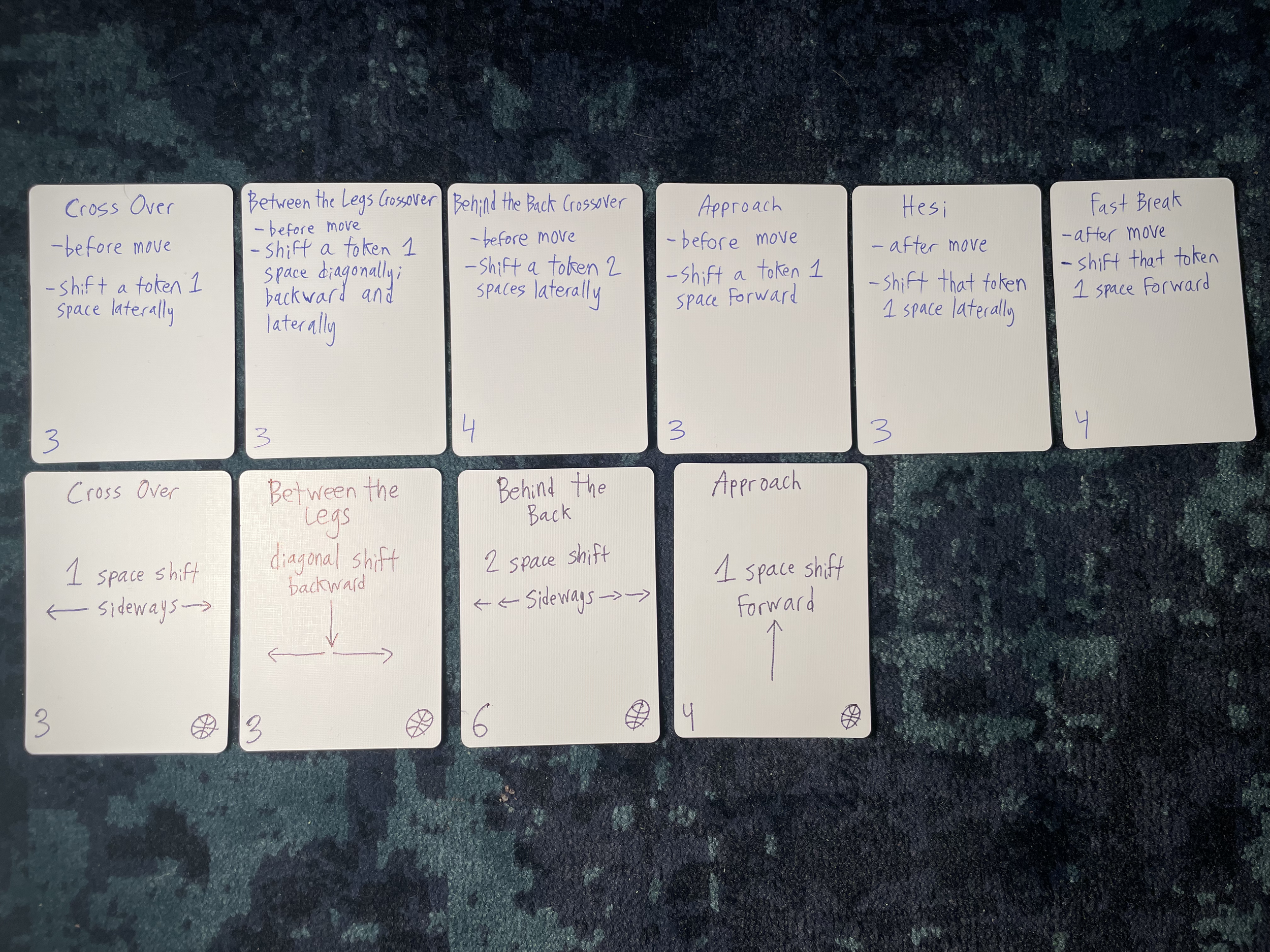
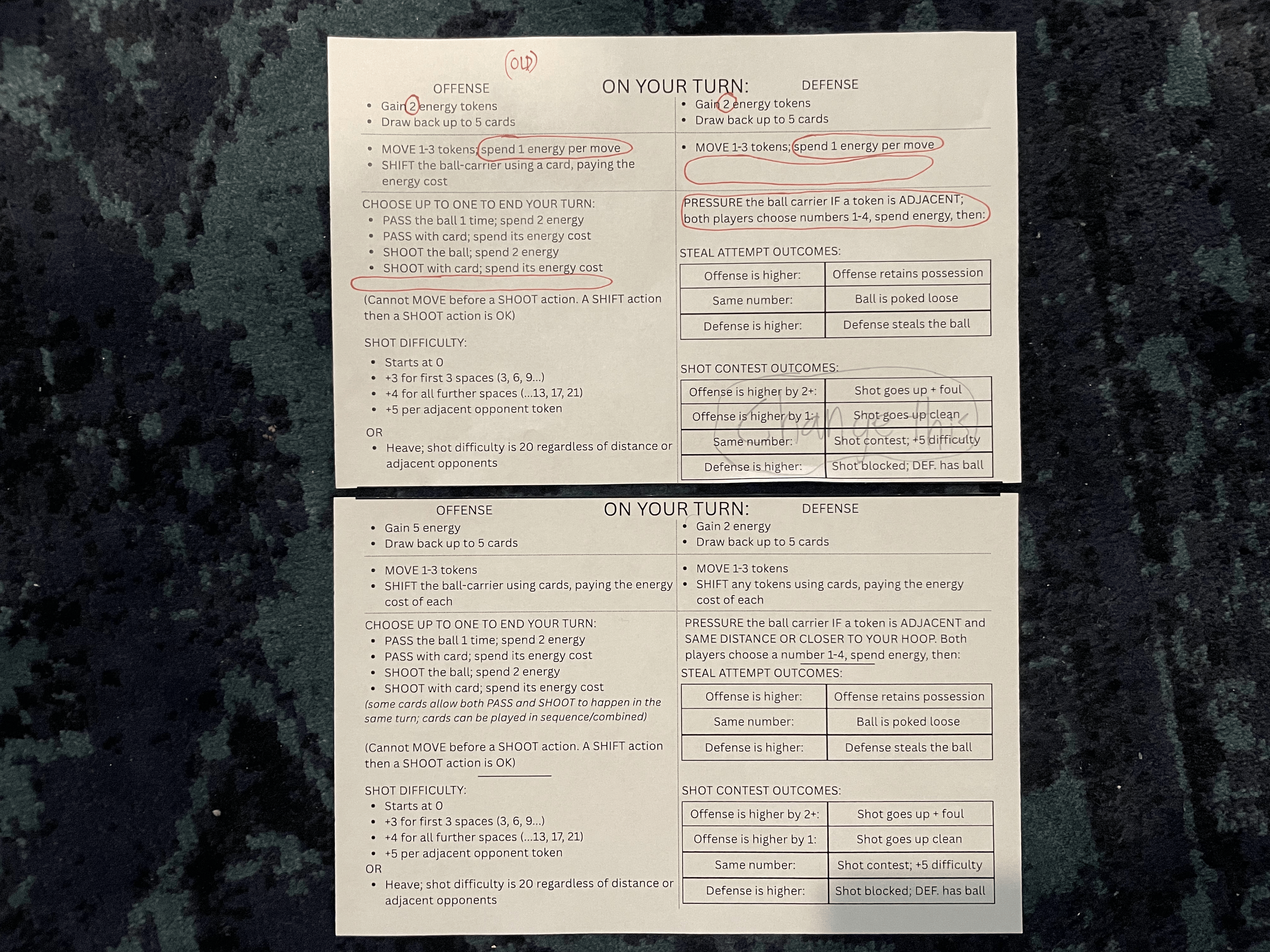
Old version (TOP) and new version (BOTTOM) of player aid card. The marked up areas of the old version are where I made changes in the newer version. There are still things I forgot to change in the new version that I need to go back and fix.
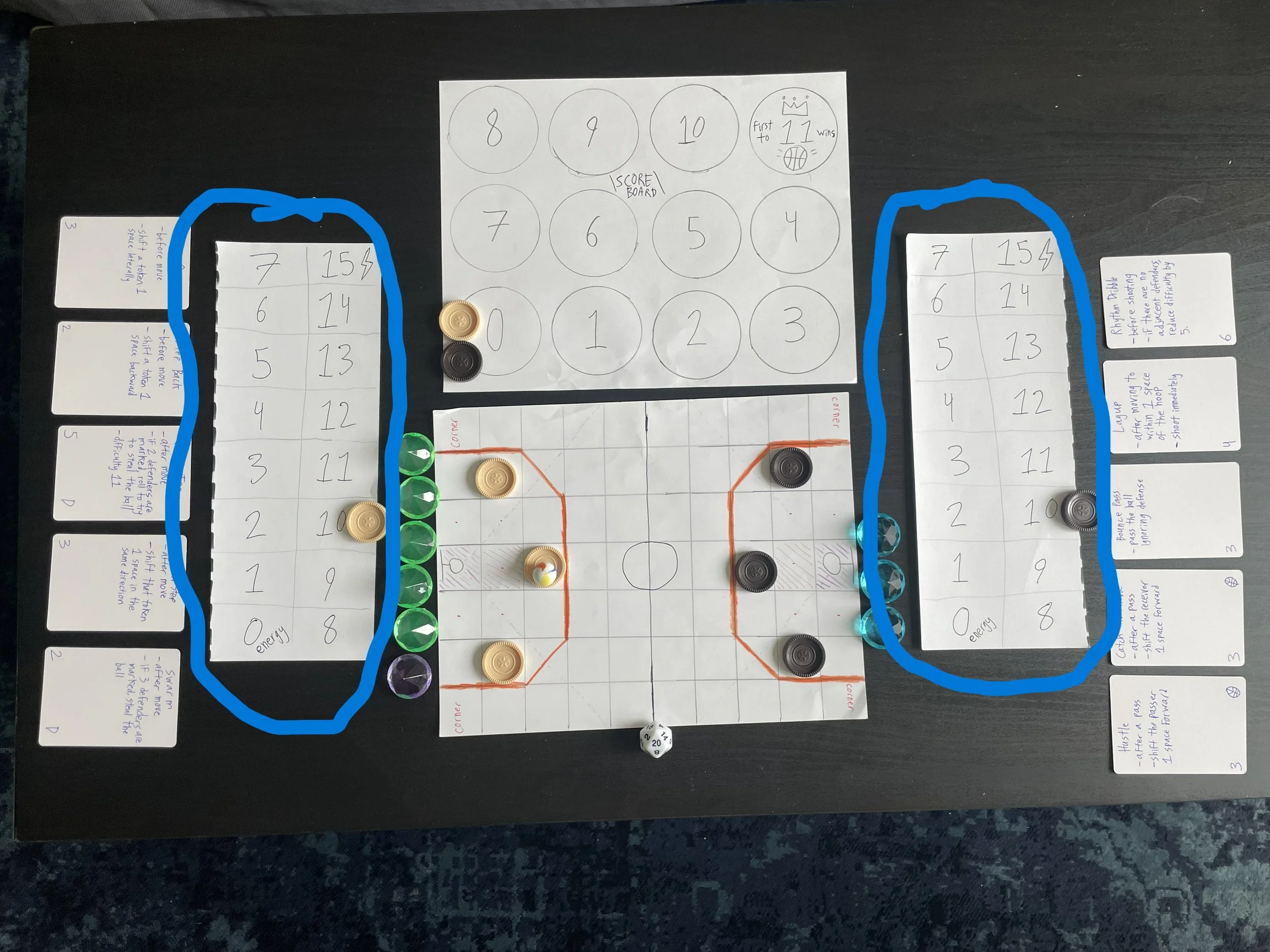
The Energy System should:
Get the player to make strategic decisions
Create room for the game to be unpredictable by allowing players to utilize card abilities if they plan accordingly
Previous movement rules:
Offense tokens could move two spaces any direction (like a queen in Chess with shortened movement)
Defense tokens acted the same exact way.
Offense and defense
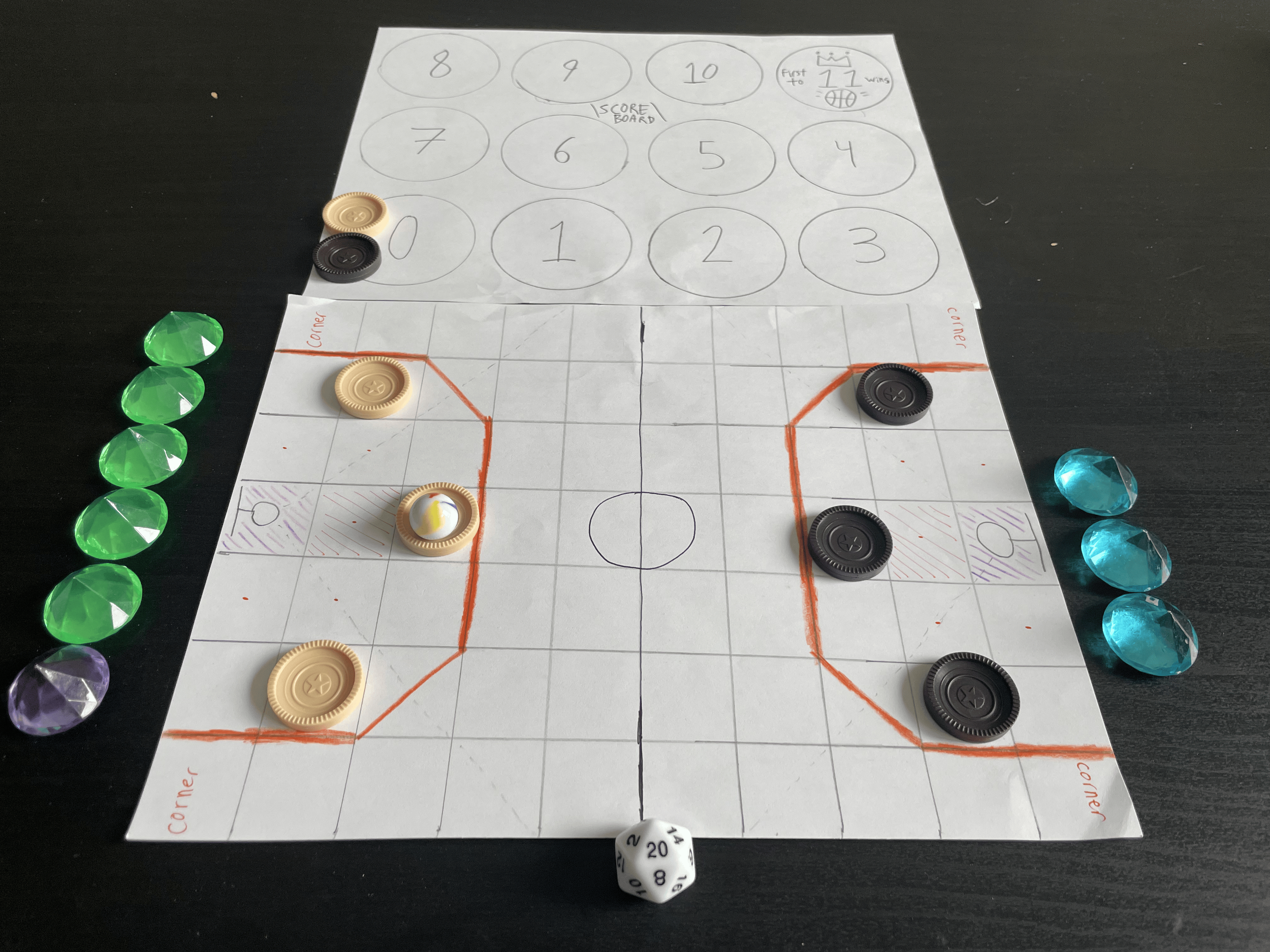
Improved version with scoring track. First to 11 wins.
There were more issues to address from the first round of playtesting. Using d20 dice for both shooting and keeping track of score was confusing, and led to players often rolling their score die for a shot.
To fix this, I needed to make it very easy to keep track of score, so I made a scoring track to move tokens along. Each circle is numbered from 0 to 11 (I lowered the winning score from 15) so players can simply move a token along the track when they score.
I had finally entered “there’s a game in there somewhere” territory. The main issue now was with how the game was designed. The primary inspiration for this game is Chess. That’s cool, but the simple movement of the pieces makes it so the game can be “solved” somewhat easily, and it wouldn’t be fun for very long.
Chess works well because of the complex and variable movement options each piece has. I wasn’t planning on having that in this game though. How would I make this game more interesting? By adding cards and turning this whole thing into somewhat of a TCG.
Players now each have an Energy Meter and an identical deck of cards that allow them to SHIFT their tokens on their turn. Players have a hand of 5 cards, and draw up to 5 at the beginning of their turn.
In the game’s rules, I made it clear that a SHIFT action is different from a MOVE action. A player may take a shot on the same turn as a SHIFT, but they cannot shoot after a MOVE action. This was an attempt at finding that balance between offense and defense that I was having trouble locking down earlier. SHIFT actions require energy, which regenerated each turn but was limited for each player.
Here’s a look at some of the cards. I gave this new version of the game with the Energy System and Card System a round of playtesting. I was met with some interesting feedback:
Too much text on the cards.
Players involved in the playtest completely ignored the cards, never engaged with the energy system, and simply played the game as it was before, only engaging with the basic movement system. So, I remade a majority of the cards with less text and more symbols (hence the multiple versions of cards) and left some of them behind. Remember the whole concept of a SHIFT action?
Trading Card Games all have their own unique qualities, but tend to have a core similarity: a “three-act-structure” for each turn.
1) Start-of-turn events and actions
2) Turn actions
3) End-of-turn events and actions
Knowing this, I tried to sculpt the core game experience around this structure, so the player was doing three main things on each turn in a routine way.
So now, SHIFT cards can be flexibly used;
1) Before a MOVE OR
2) After a MOVE
…as the player wishes. There was still plenty of room to think of creative card types that engage with, and slightly bend, other game rules. For example, a “Catch And Shoot” card that lets a player PASS and SHOOT in the same turn, which isn’t normally allowed.
Some other feedback came out of that same playtest:
It took a long time to explain the rules.
This is true; I took time making sure both players understood the rules and also moved pieces around on the board to demonstrate examples of player actions being taken. But even as I tried to keep the explanation simple, I realized there were quite a few things players had to memorize.
To keep the flow of the game going, I decided to make player aid cards (which are a part of most tabletop games) for players to reference.
By this point, I had also gotten rid of “marked” defensive tokens because I didn’t like how random the rules I designed for it felt. Similar to shooting, the defender would roll a d20, and would either steal the ball, poke it free from the offense, or miss. I redesigned this so the defense had a more meaningful choice to make each turn in their attempt to get the ball back.
Maybe you saw these earlier. These track how much '“energy” each player has. Using cards costs energy. The first big mistake?
Making everything cost energy.
Even things as simple as moving and passing the ball cost energy. I thought this was a good idea because it forced the player to be strategic about every move and action. But having every single action trigger a change in energy means there’s a lot of admin during each player’s turn, and it sucked the fun out of the game. To fix this, I had to get really clear about what the whole point of the energy system was, and why I was trying to expand the game in that way.
The Energy System should not:
Consistently interrupt or impede the core gameplay
Encourage players to take a long time to make decisions
Cards, then, would be the primary component in the game that uses energy.
Initially, I made the game board 7 squares wide and 10 spaces long.
However, I noticed that the offence and defense didn’t interact with eachother very much. If pieces could only move 2 spaces per turn by default, it took a whole three turns to even have your pieces within a reasonable shooting range of the opponent’s hoop. This is wasted time and it’s not fun because it doesn’t help create the feeling of back-and-forth basketball across a court. Because of this, I changed some rules.
I shortened the length of the court by 2 spaces.
This meant the game would now be played on a 7×8 court, very similar in size to a regular checkerboard. I also tested a 5×10 and a 5×8 court, and found that the 7×8 dimensions supported the tabletop gameplay in the best way.
There was also another issue.
It was too easy for the defense to contest the offense turn after turn and drain the offense’s energy meter. The defense simply had to be:
adjacent to the ball carrier
equally distant (or closer by 1 space) to their own hoop than the ball carrier
Because all tokens moved the same speed, the defense had no trouble keeping up with the offense to pressure them (and potentially steal the ball) on every turn. So I changed the rules of movement.
New and improved movement rules:
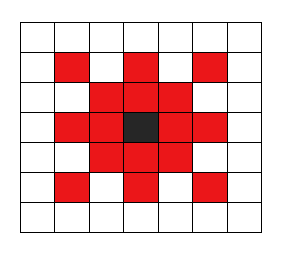
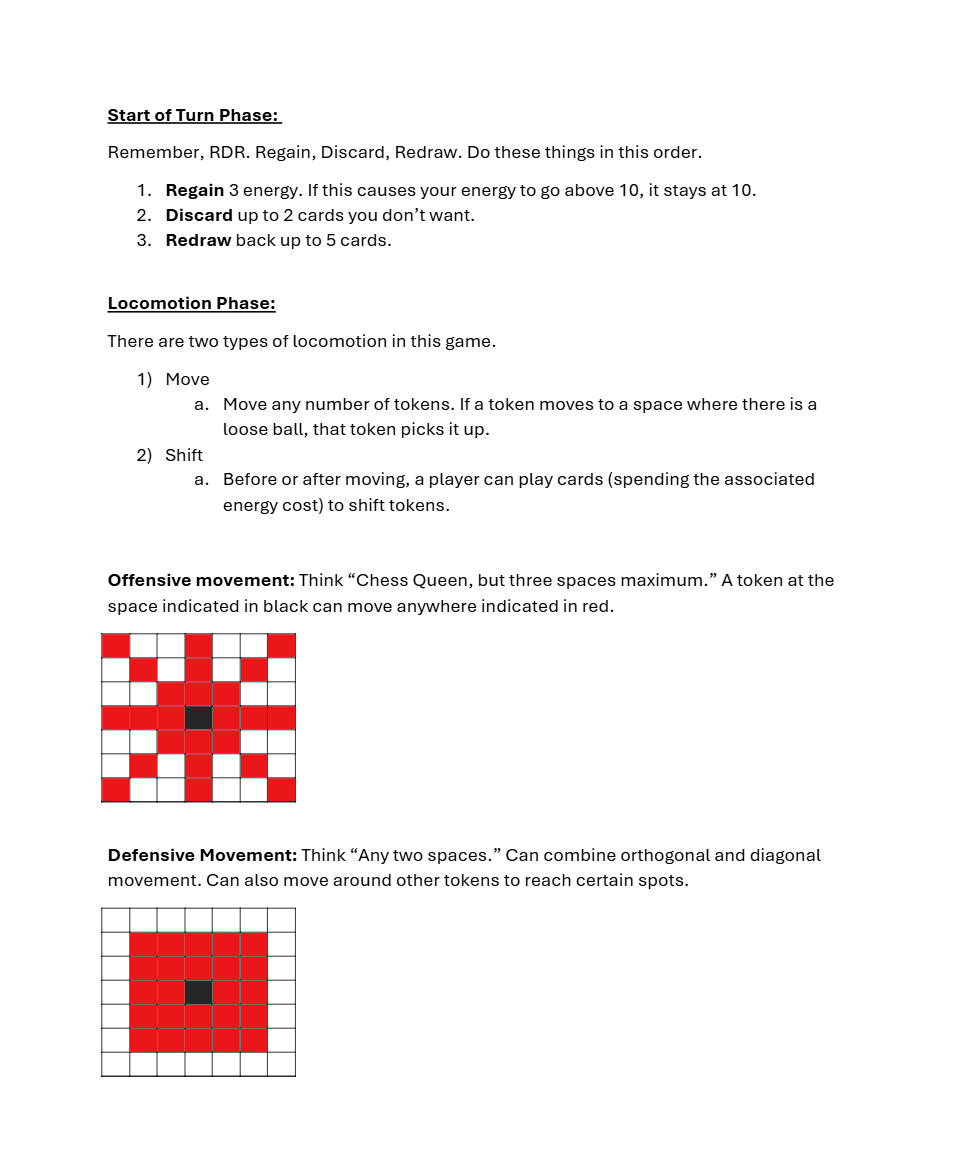
Offense tokens can move three spaces any direction
Defense tokens can move ANY two spaces (even if they change direction mid-move)
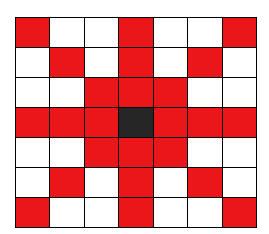
Offense
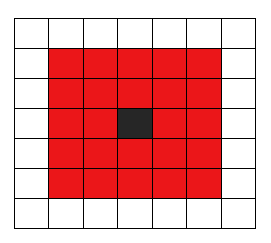
Defense
This was a productive change
because offensive tokens now had the opportunity to break away from defensive tokens placed in sub-optimal positions. However, offensive tokens now needed to find open lanes to move three spaces in the same direction, while the slower but more nimble defenders were now more effective closer to their own hoop.
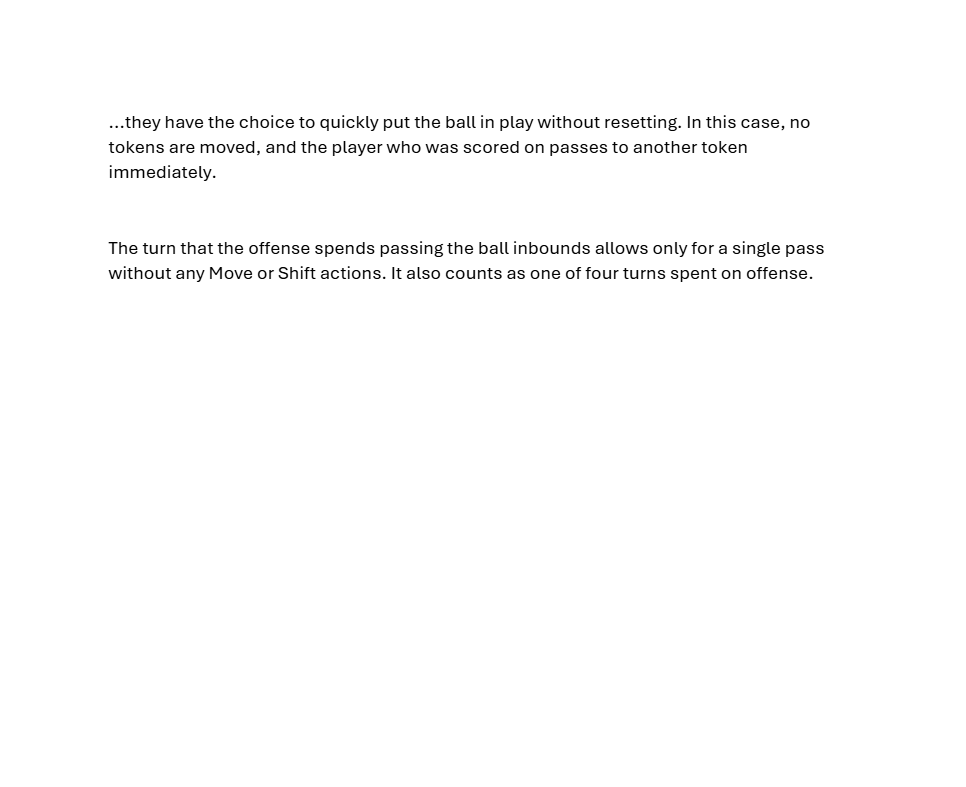
I also designed rules to let a player in-bound the ball whenever it is scored or goes out of bounds.
The defense establishes their token positions first, then the offense places theirs so they can pass the ball from a token on the court’s boundary line into play.
This type of reset allows both players to think over how they want to approach the next play
given which cards they have in their hand, and also simulate a part of basketball that rewards players who put the ball back in play strategically. This also makes the game feel more fluid because each play flows into the next, as opposed to having each play feel like a round of a card game that could be played in isolation.
The next issue I needed to solve was related to passing.
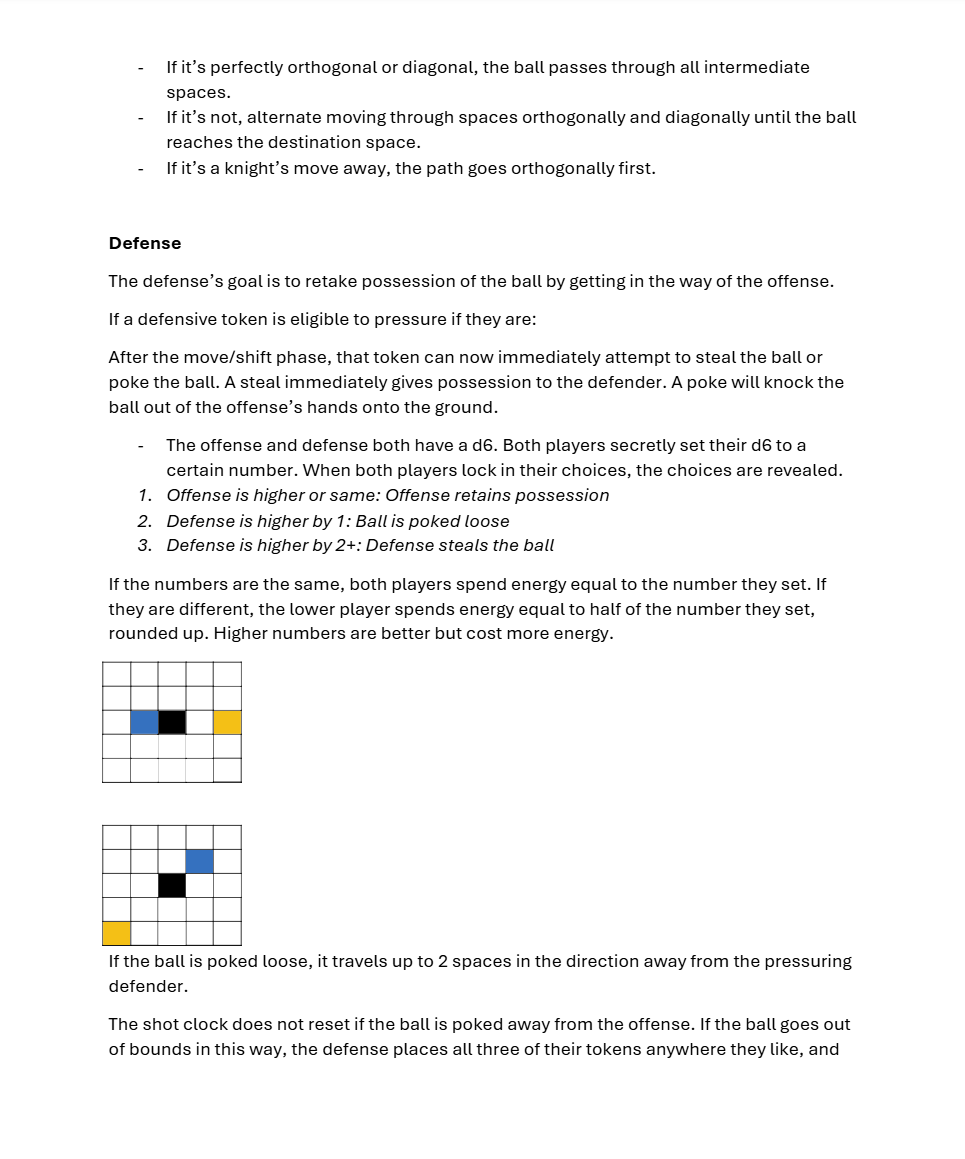
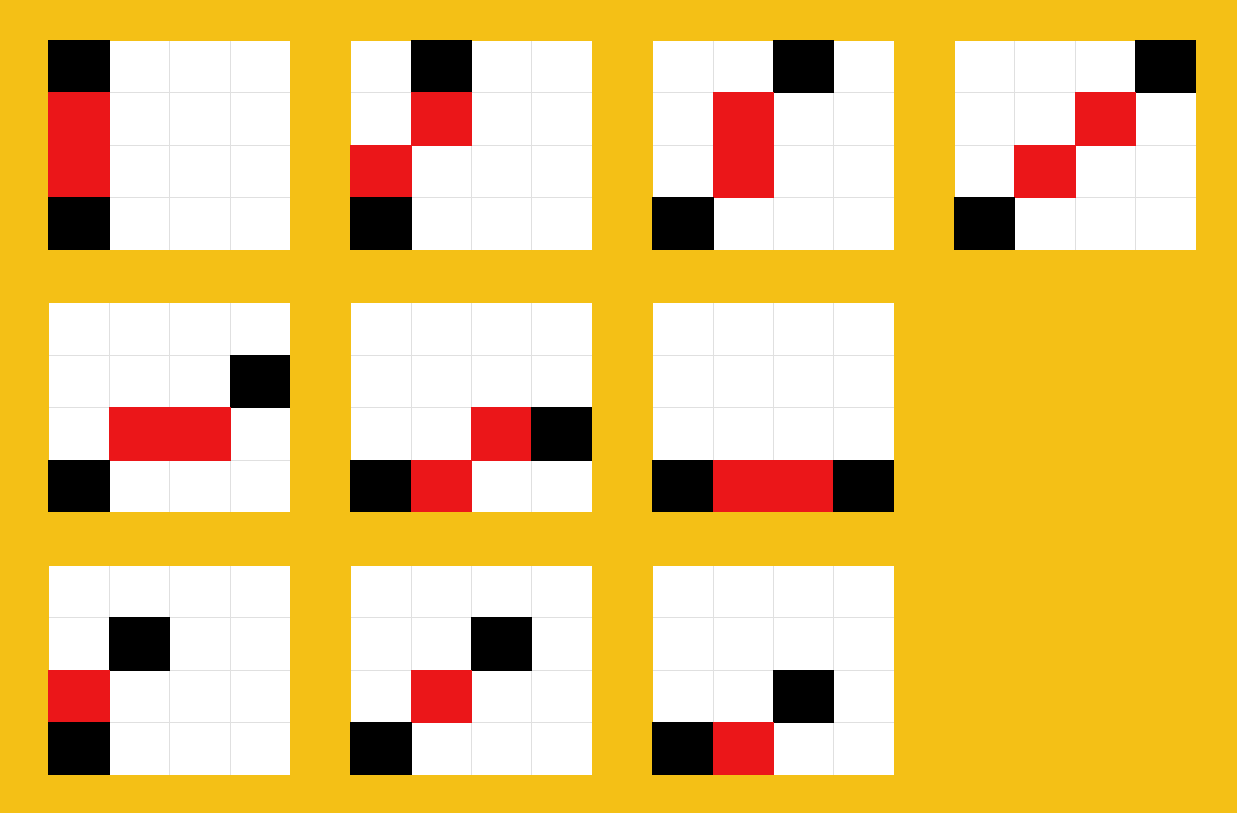
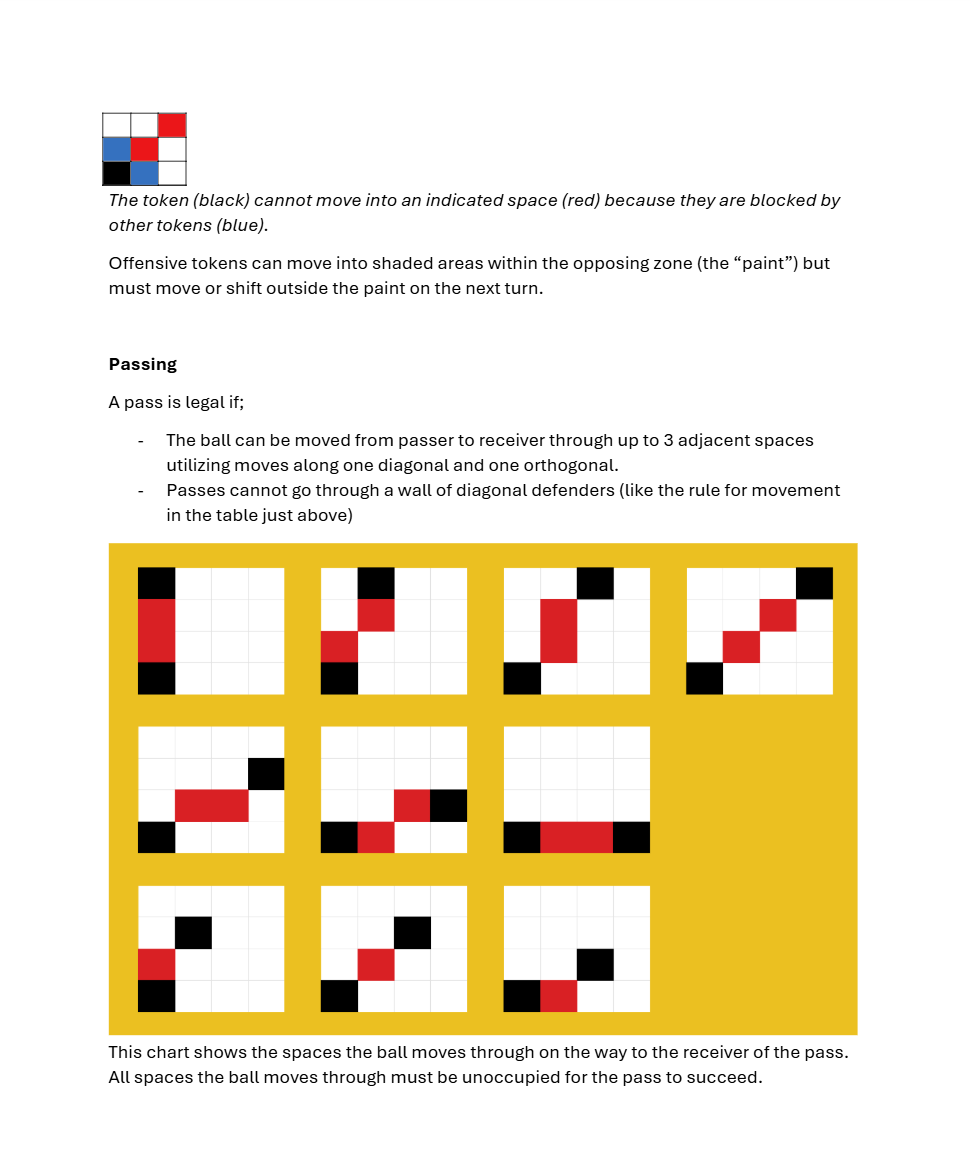
During a playtest, there was a time where a player wanted to pass the ball between two tokens, but they didn’t know if the position of a defending token was actually in the way or not. Currently the rule stood where a token could pass the ball up to three spaces, but it wasn’t exactly clear which spaces the ball passed through on the way to the token receving the pass. That’s where this guide comes in:
Straight line → straight line
Slightly diagonal → alternate orthogonal and diagonal directions
Knight’s move → orthogonal first, then diagonal
So I made a change. Here was the new idea:
both players secretly set a 6-sided die to have a certain number on the top face
once both players are locked in, they reveal their numbers
only the higher player spends energy equal to the number they set, while the other player doesn’t spend any energy. If its tied, both players spend energy.
if the offense’s number is equal or higher, they keep the ball. If the defense’s number is higher, they steal the ball.
Problem: It was too easy for the defender to get the offense to waste energy keeping the ball on one turn, only to create an easy stealing opportunity next turn.
This was another “find the happy medium between two extremes” issue. Pressuring the ball carrier (and being pressured by a defender) needed to carry some element of risk, but it shouldn’t punish players for playing the game correctly:
both players secretly set a 6-sided die to have a certain number on the top face
once both players are locked in, they reveal their numbers
the higher player spends energy equal to the number they set, while the other player doesn’t spends energy equal to half their number rounding up. If its tied, both players spend energy.
if the offense’s number is equal or higher, they keep the ball. If the defense’s number is higher, they steal the ball.
This balance actually works really well. There’s now no obvious amount of energy to spend on attempting to steal or keep the ball, and there’s still a great amount of risk involved for both sides.
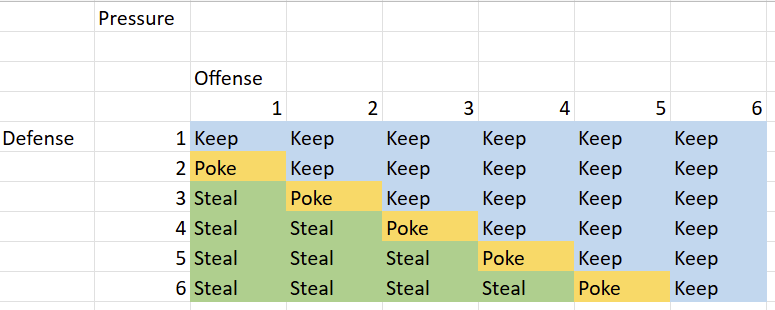
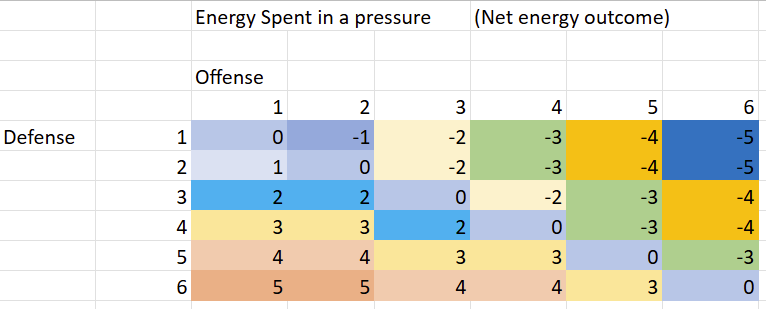
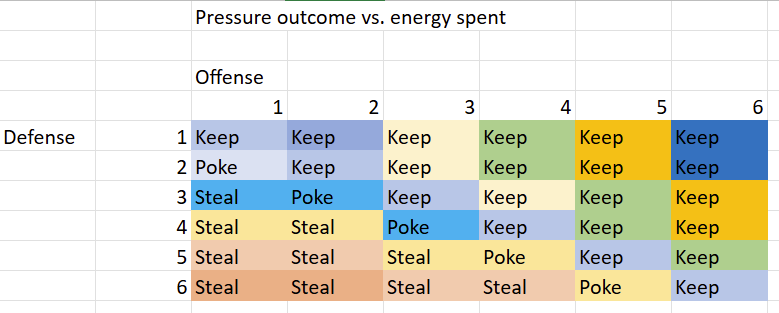
There’s a detail I omitted.
If the defense’s number is higher by exactly 1, they poke the ball loose for another token to pick it up. Higher by 2, and the defense cleanly steals the ball.
This chart is exciting.
This shows the net amount of energy made up or lost by the offense in an attempt to keep the ball depending on how much energy each player chooses to spend.
And here’s an aggregate of both charts in one.
The best outcome for the offense is spending energy equal to the defense. Slightly worse is overspending energy, and worse yet is underspending energy and losing the ball.
I added a rule to make steals more exciting.
The rule is as follows:
If the defense gets the ball back from a clean steal, they immediately take an offensive turn with the ball.
This allows the team who just got the ball to immediately generate some positive momentum towards scoring instead of rewarding the team who just lost the ball with a chance to snag it right back.
With the new 7×8 court, I added some new rules and changed some old ones.
Here’s what changed and why:
1. Shift spaces.
If a token shifts to one of these spaces and makes a shot, it counts as 3 points, whereas a shot from a Shift space without a shift beforehand is worth 2. Players will naturally want to land on these spaces using Shift, but the defence knows this too. This gives the offense more options to attack the hoop.
2. Arrow spaces.
These change the 'forward' direction for the tokens on them for all Shift cards. This makes it easier to drive to the basket using the same cards to move in a different direction.
3. Lucky bounce numbers.
On a missed shot, the shooter rolls a 6-sided die, and the ball either bounces out to the space marked with the number rolled, or takes a lucky bounce and goes in with a 6. Not only does this add a potentially exciting twist to make more shots go in, it also allows for players to employ more strategy about where to position tokens for rebounds. If a token occupies the space where the ball bounces out to, they immediately catch it, just like a loose ball.
You may have noticed some areas demarcated around the perimeter of the grid.
These are areas where a player can position a token to in-bound the ball from out of bounds. Remember, the defence has to establish the positions of all their tokens first, then the offence places their tokens to attack it.
The reason these areas are four spaces wide is because the defense has only three tokens to set up on defense.
If the offense had to inbound from one specific space, the defence could form an impassible wall that the offence couldn’t get a pass through. With four spaces to put a passing token on, the defence knows this wall strategy would be a futile attempt to stop an inbound, so they should instead set up their defence closer to their own hoop and defend properly.
And that’s where I decided that the game was done.
At this point, I had a Basketball themed tabletop game that:
forced players to approach offensive and defensive scenarios differently
manage limited energy across 3 different player tokens
provided room for expression of a specific playstyle with the cards a player chooses to put in their deck at the start of a game
It took a while to find the balance I wanted between offence and defense.
At some point, I decided the game would feel more NBA Jam than an actual NBA or College Basketball game, so it’s still somewhat easy to score. The biggest decision a player has to make, however, is to go for 2 points or 3 points. On the path to 11 points, a player can win in 4 scores even if one of them is a 2-pointer, so both kinds of scoring are encouraged. In a game to 21 points, players are unlikely to succeed at making seven 3-point shots in a row, and scoring points will always be better than conceding a turnover, so 2-pointers are still valuable.
Scoring frequently means that every change of possession without a score will change the momentum of the game significantly.
This change of momentum is also supported by awarding a free turn to the team who won the ball back. At the end of the day, I had made a game that was Basketball, Chess, and a Trading Card Game all in one. I’ll see you on the court.
I changed the rules that allow the defense to pressure the offense.
The pressure would involve both players in a minigame, where this would happen:
both players secretly set a 6-sided die to have a certain number on the top face
once both players are locked in, they reveal their numbers
both players spend energy equal to the number they set
if the offense’s number is equal or higher, they keep the ball. If the defense’s number is higher, they steal the ball.
Problem: The defense would be punished for trying to take the ball back by losing energy and still not getting the ball.