Scoreboard Toys
I like sports, and I like designing games.
I also hosted a club at DigiPen Institute of Technology that involved playing many different kinds of games. The objective of these projects was to create a fun way to keep track of scores for competitions by giving them some additional context; either a sport or something different.
These scoreboards are designed with a low level of detail on purpose so as to not distract from the main activity.
Remember, these scoreboards are supplements to other games. Players would earn field position (or the ball back) depending on wins and losses in a certain video game, so the job of the scoreboard is to present that information as clearly as possible.
2: Basketball
This scoreboard is a bit different from the previous:
Presents the current score
Allows for the spawning and shooting of basketballs
Automatically tracks score and shows time remaining in the current quarter
3: Ridiculous scoreboard
This scoreboard is massively different from the previous ones:
Presents scores for a virtually unlimited number of teams
Allows for customizable team names and colors
Utilizes 6 different mathematical operators to modify scores
Allows teams to have scores with up to 60 digits in them
This scoreboard actually requires players to play it using the keyboard.
It was important to make this scoreboard meaningfully different from the previous. Once a player gets a hang of the controls, it’s not very challenging to score most of your shots. This means a lead of, say, 14 points is not that big of a difference in this game compared to Football.
These tools - and the mechanics they provide to create a competition around other games - are similar: they are based on risk vs. reward comparisons.
In the American Football game, the offense finds themselves on 4th down if they lose a game. They can then either:
try to pick up a first down: high risk, high reward, as it could lead to a touchdown or a turnover
attempt a field goal: low risk, low reward, as it could lead to 3 points or a miss and giving up the ball
punt the ball back to the other team: no risk, no reward, as the other team takes over far away from the kicking team’s endzone
In the Basketball game, players earn a certain number of shots depending on how well they do in games where player’s performances are ordinally ranked (1st, 2nd, 3rd, etc). Players can choose to shoot for 2 points or 3 points.
shooting for 3 points: high risk, high reward, as it is more difficult
shooting for 2 points: medium risk, medium, as it is easier
This scoreboard would be used for activities that are similar to television game shows, like trivia games.
The fun of this scoreboard lies in being able to generate numbers that only otherwise get used in incremental games. There’s something charming about watching your score interpolate up to the new value after a large gain of points. However, simply seeing a long string of digits isn’t very meaningful, so it was important as well to add an approximation of how many points each team has.
I would later return to the Football and Basketball scoreboards to add more features to them.
I felt like, for each of them, they were missing something critical, or that there was a missed opportunity to add something to add entertainment value.
On the Football scoreboard, it is now possible to miss field goals.
A very tiny indicator in the top middle of the scoreboard (above the timer) that players aren’t supposed to notice shows that a field goal will be missed, and it is toggled by the keyboard.
Now, there’s actually a reason for players to watch the field goal kick, because there’s a level of uncertainty about whether the kick will be successful until it makes it all the way through. Also, the scoring buttons are still independent from the ball movement, because of two (similar) things:
If the ball is advanced into the endzone, it is unknown if it is a touchdown or a 2-point conversion.
If the ball is kicked between the uprights, it is unknown if it is a field goal or a PAT.
These ways of scoring are worth different amounts of points, and even still, I prefer to keep the program simple by having scoring controls independent from ball movement.
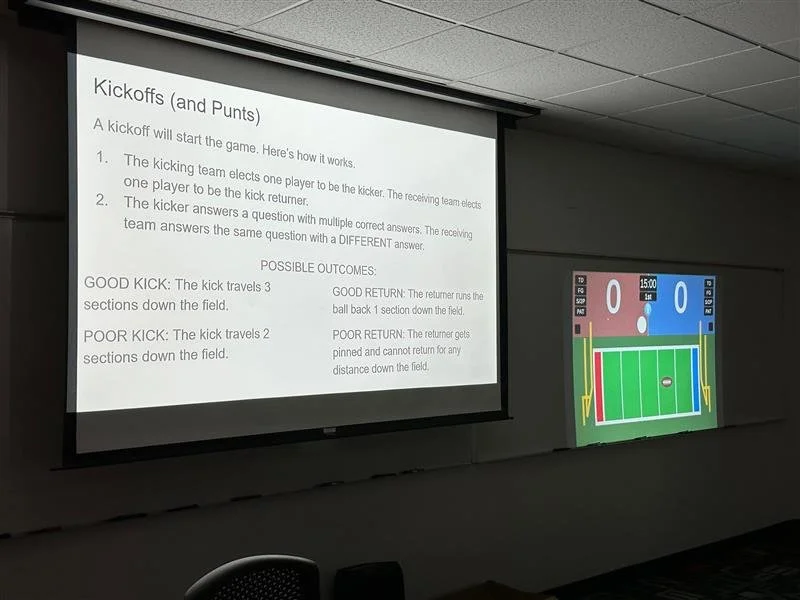
Here’s the scoreboard in action.
Before this event, I taught players how answering trivia questions will influence the position of the ball on a kickoff or a punt. Not only do players have to be skilled at the games, they have to be knowledgeable enough to answer trivia questions correctly to kick properly (field goals, punts, etc.).

Here I am hosting the main event, with Mario Kart: Double Dash!! on the main screen.
The outcome of the race will determine if the offense advances (and how far), if they end up in a 4th down situation, or if they fumble the ball.
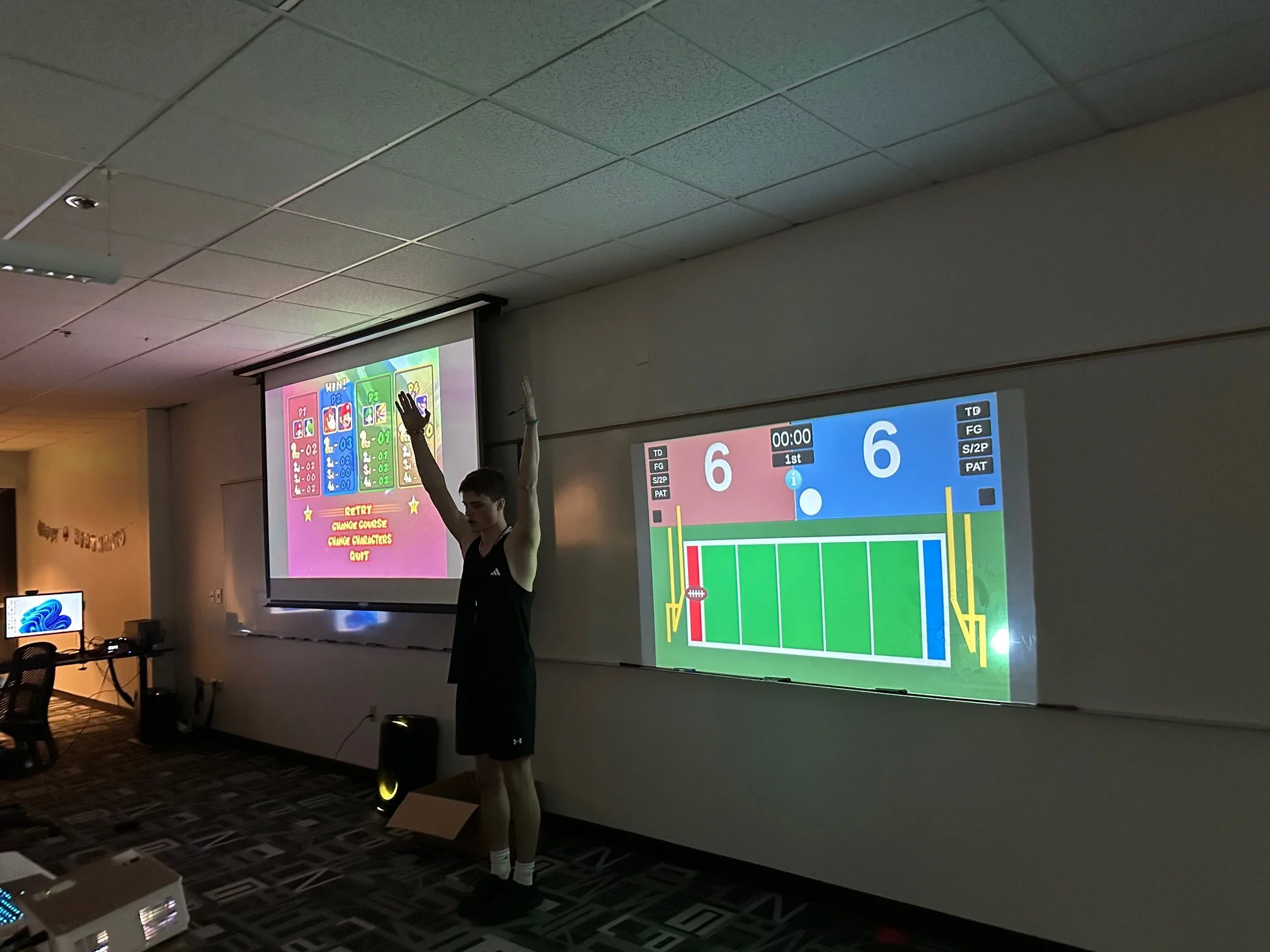
The Blue team scores a touchdown by having a player on offense get 1st place.
I also act as the referee for these things too. Here I am in the “arms-up touchdown” pose to indicate that.
On the Basketball scoreboard, it was already possible to spawn virtually as many basketballs as the player wanted.
However, if many basketballs are shot at the same time, many of them will be bounced away from the target hoop, and not many will go in. What if the player could enter a mode of play where they couldn’t miss a single shot, even if they tried?
I added this primarily for the surprise factor.
Again, there’s a tiny indicator (this time in the top left of the green banner, or top right of the purple banner) showing which hoop the basketballs will score in while the program is in “Guided Mode”, but players aren’t supposed to see that.
This feature also serves another purpose, and that is to quickly increment the score of a certain team. There are no scoring buttons here, so this practically serves that function.
1: American Football
This scoreboard has several functions:
Presents the current score
Shows the position of the ball
Shows time remaining, the current quarter, and which team has possession
Provides visuals for field goals